A Study of Sidewalk Quality and Pedestrian Environment in the Don Mueang International Airport Area, Bangkok
Article Sidebar
Main Article Content
Abstract
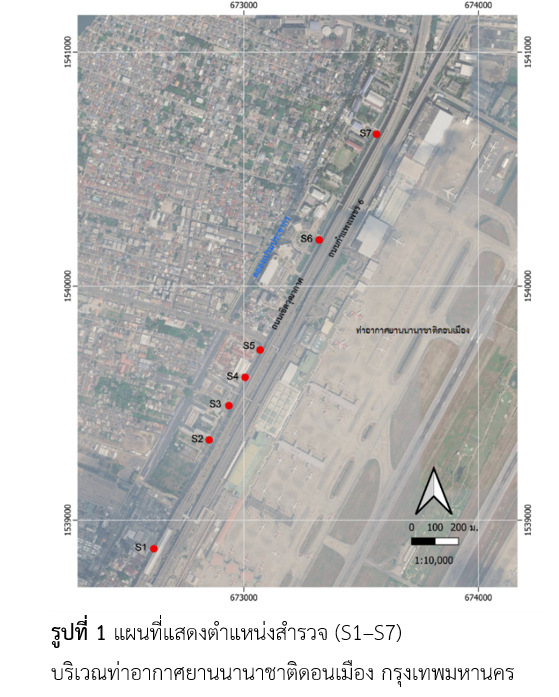
This research aimed to investigate the quality of sidewalks and the pedestrian environment in the vicinity of Don Mueang International Airport, Bangkok, by evaluating four aspects: safety, route continuity, facilities, and obstacles, as well as comparing sidewalk quality among the study areas. A field survey was conducted at seven study sites covering approximately 6 kilometers of pedestrian routes during October 2025. Data were collected on the physical characteristics of sidewalks, including sidewalk width, pavement condition, level differences, slope, lighting, facilities, and obstacles. The collected data were then comparatively analyzed to evaluate sidewalk quality across the study sites. The results revealed that sidewalk quality and the pedestrian environment varied among the study sites. Sidewalk widths ranged from 0.81 to 2.49 m, and only two study sites met the Bangkok Metropolitan Administration (BMA) standard requiring a minimum sidewalk width of 1.50 m. The major limitations included insufficient sidewalk width, discontinuous pedestrian routes, inadequate facilities for persons with disabilities, and the presence of obstacles such as utility poles, traffic signs, trees, and overhead cables, all of which affected pedestrian convenience and safety. The findings can be used to support sidewalk improvement by prioritizing route continuity, reducing physical obstructions, and improving accessibility facilities for all users, thereby promoting safe walking and improving access to public transportation.
Article Details

This work is licensed under a Creative Commons Attribution-NonCommercial-NoDerivatives 4.0 International License.
References
ณิชนันทน์ บุญอ่อน และวงศ์พันธ์ ลิมปเสนีย์, “การพัฒนาทางเท้าเพื่อกรุงเทพมหานครเมืองสะดวก: กรณีศึกษาทางเท้าตามแนวเส้นทางรถไฟฟ้าสายสีเขียวอ่อน (สายสีลม),” วชิรเวชสารและวารสารเวชศาสตร์เขตเมือง, ปีที่ 64, ฉบับที่ 3, หน้า 213-222, 2563.
อภิรักษ์ ปาดล และพีระพล เอี่ยมตระกูล, “การวิเคราะห์ความสามารถในการเดินเท้าตามแนวคิดการพัฒนาพื้นที่รอบสถานีขนส่งมวลชน,” วารสารวิชาการด้านสถาปัตยกรรมศาสตร์, ปีที่ 19, ฉบับที่ 2, หน้า 19-33, 2565.
กรุงเทพมหานคร. “กรุงเทพฯ เดินได้ เดินดี: พัฒนาทางเดินเท้าคุณภาพ, “ [ออนไลน์]. https://greener. bangkok.go.th/pavement-bang kok/. (เข้าถึงเมื่อ: 25 มกราคม 2569).
สำนักงานผู้ตรวจการแผ่นดิน. “ข้อเสนอแนะการแก้ไขปัญหาทางเท้าสาธารณะในกรุงเทพมหานคร,” [ออนไลน์]. https://ombstudies.ombudsman. go.th/ewt_news.php?nid=2831. (เข้าถึงเมื่อ: 25 มกราคม 2569).
ThaiPublica. “กทม. ปรับปรุงทางเท้าทั่วกรุงฯ ‘เดินได้ เดินดี น่าเดิน’ ทะลุเป้ากว่า 1,100 กม.,” [ออนไลน์]. https://thaipublica.org/2025/08/bkk-improved-sidewalks-pedestrian-friendly/. (เข้าถึงเมื่อ: 28 มกราคม 2569).
ปุณณวิช นาแสงวาณิช, คฑาวุธ พรมรินทร์ และพงษ์สันธ์ บัณฑิตสกุลชัย, “อิทธิพลของคุณภาพทางเท้าต่อการเลือกเดินเท้าเพื่อเชื่อมต่อระบบขนส่งมวลชนทางราง,” โครงงานวิศวกรรมโยธา (บทความวิจัย), ภาควิชาวิศวกรรมโยธา คณะวิศวกรรมศาสตร์ จุฬาลงกรณ์มหาวิทยาลัย, 2567.
พิชชาภา เมฆมานะ, “การศึกษาสภาพแวดล้อมที่ส่งเสริมการเดินเท้ารอบสถานีรถไฟฟ้า: กรณีศึกษาสถานีปุณณวิถีและสถานีสุทธิสาร,” วิทยานิพนธ์ ภ.สถ.ม. (ภูมิสถาปัตยกรรมศาสตร์), มหาวิทยาลัยศิลปากร, นครปฐม, 2566.
สุรวุฒิ วุฒิภัทราภิวัฒน์, “แนวทางการจัดการทางเท้าสาธารณะที่เหมาะสมสำหรับประชาชนในกรุงเทพมหานคร,” สารนิพนธ์ รป.ม. (นโยบายและการจัดการสาธารณะ), มหาวิทยาลัยศรีนครินทรวิโรฒ, กรุงเทพฯ, 2565.
J. Gehl, Cities for People, Washington, DC: Island Press, 2010.
M. Southworth, “Designing the walkable city,” Journal of Urban Planning and Development, vol. 131, no. 4, pp. 246-257, Dec. 2005. doi: 10.1061/(ASCE)0733-9488(2005)131:4(246).
Transport Research Laboratory, Pedestrian Environment Review System (PERS) User Guide (Application Guide AG40), TRL Limited, 2004.
San Francisco Department of Public Health, The Pedestrian Environmental Quality Index (PEQI): An Assessment of the Physical Environment Through Systematic Pedestrian Survey, Program on Health, Equity and Sustainability, San Francisco, CA, 2008.
Cain, K. L., Millstein, R. A., Geremia, C. M., Sallis, J. F., Adams, M. A., Frank, L. D., & Saelens, B. E. (2014). Contribution of streetscape audits to explanation of physical activity in four age groups based on the Microscale Audit of Pedestrian Streetscapes (MAPS). Social Science & Medicine, 116, 82–92. https://doi.org/10. 1016/j.socscimed.2014.06.042
H. V. Krambeck, “The Global Walkability Index,” Master's thesis, Massachusetts Institute of Technology, Cambridge, MA, USA, 2006.
สมัชญ์ เอี่ยมสอาด และจิดาภา ถิรศิริกุล, “แนวทางการแก้ไขปัญหาทางเดินเท้าในพื้นที่เขตบางแค กรุงเทพมหานคร,” วารสารการบริหารและสังคมศาสตร์ปริทรรศน์, ปีที่ 7, ฉบับที่ 2, หน้า 183-191, มีนาคม-เมษายน 2567
มาริสา หิรัญตียะกุล, “ปัจจัยที่ส่งเสริมเมืองเดินได้สำหรับผู้สูงอายุโดยใช้การท่องเที่ยวมรดกวัฒนธรรม: กรณีศึกษาย่านเมืองเก่านครราชสีมา ประเทศไทย,” Asian Creative Architecture, Art and Design (ACAAD), vol. 39, no. 1, e278452, 2569. doi: 10.55003/acaad.2026.278452.
X. Huang, H. Liang, L. Zeng, and M. White, “Evaluating urban walkability: A comprehensive review of tools and techniques,” Architectural Science Review, vol. 68, no. 4, pp. 263-277, 2025. doi: 10.1080/00038628.2024.2410731.
S. A. Zakaria, M. A. Marzukhi, and A. F. Bakri, “Exploring urban liveability: The key performance indicators for walkability,” Built Environment Journal, vol. 22, Special Issue, pp. 399-414, 2025. doi: 10.24191/bej.v22iSI.5641.
สมาคมสถาปนิกผังเมืองไทย, ข้อแนะนำการออกแบบบาทวิถีและสิ่งแวดล้อมเพื่อทุกคน (Design Recommendation on Pathways and Environments for All), กรุงเทพมหานคร: สมาคมสถาปนิกผังเมืองไทย, 2561.
กรุงเทพมหานคร, รายงานการศึกษากายภาพถนนในกรุงเทพมหานคร ปี 2566, กรุงเทพมหานคร: กองนโยบายและแผนงาน สำนักการวางผังและพัฒนาเมือง, 2567.
