Influence of Fertilizer Application on Growth, and Quality in Champedak Artocarpus integer (Thunb.) Merr.
Article Sidebar
Main Article Content
Abstract
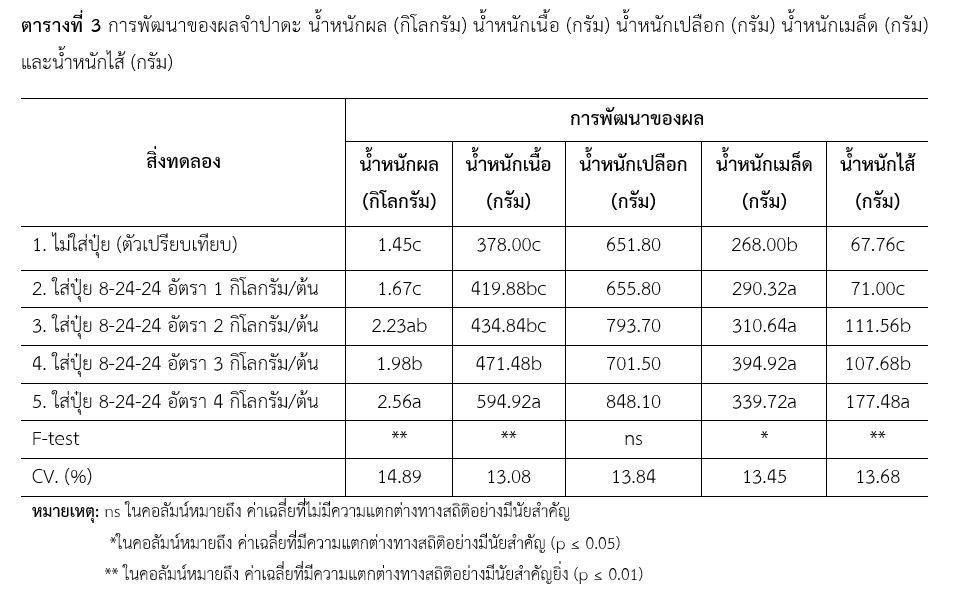
This study was conducted to examine the effects of fertilizer application on the growth and fruit quality of Champedak (Artocarpus integer). The experiment took place in a farmer’s Champedak orchard located in Lan Saka Subdistrict, Lan Saka District, Nakhon Si Thammarat Province, from November 2023 to September 2024. A Completely Randomized Design (CRD) was employed, comprising 25 Champedak trees assigned to five treatments, with five trees per treatment. Fertilizer was applied in two separate periods as described below. During the first fertilization period, which aimed to enhance vegetative growth in terms of stem and leaf development, five fertilizer treatments were applied. Treatment 1 served as the control with no fertilizer application. In Treatment 2, fertilizer formula 21-0-0 was applied at a rate of 1 kg per tree. Treatment 3 received fertilizer formula 15-0-0 at the same rate, while Treatment 4 was supplied with fertilizer formula 46-0-0 at a rate of 1 kg per tree. Treatment 5 was given fertilizer formula 11-0-0 at a rate of 1 kg per tree. The results showed that the application of fertilizer formula 46-0-0 at a rate of 1 kg per tree produced the highest percentage of new shoot emergence, indicating that this treatment was the most effective in promoting vegetative growth of champedak trees. During Period 2, fertilizer application was carried out to promote flowering, enhance nutrient accumulation, induce flower formation, and support fruit development and quality. Fertilizer formula 8-24-24 was applied at varying rates across five treatments. Treatment 1 served as the control with no fertilizer application, while Treatments 2, 3, 4, and 5 received fertilizer at rates of 1, 2, 3, and 4 kg per tree, respectively. The results indicated that the application of 8-24-24 at 4 kg per tree had the most fruit development, and fruit quality. This treatment produced the highest values for fruit circumference, fruit length, fruit weight, pulp weight, seed weight, rind thickness, and pulp sweetness, demonstrating its effectiveness in improving both the quantitative and qualitative characteristics of Champedak fruit.
Article Details

This work is licensed under a Creative Commons Attribution-NonCommercial-NoDerivatives 4.0 International License.
References
วิภาวรรณ วงศ์สุดาลักษณ์,”ผลิตภัณฑ์ข้าวเกรียบจากเมล็ดจำปาดะ,” ใน รายงานสืบเนื่องจาการประชุมวิชาการระดับชาติ มหาวิทยาลัยราชภัฏสงขลา ครั้งที่ 6, จังหวัดสงขลา, 15-16 สิงหาคม 2559, หน้า 1116-1122.
วิลาสินี ธนพิทักษ์ เทพรัตน์ จันทพันธ์ วิวัฒน์ ฤทธิมา พรชัย ลิขิต ธรรมโรจน์ สรพงค์ เบญจศรี และ สมัคร แก้วสุกแสง, “ความหลากหลายและลักษณะทางสัณฐานวิทยาของจำปาดะในตำบลเกาะยออำเภอเมือง จังหวัดสงขลา,” วารสารแก่นเกษตร แก่นเกษตร, ปีที่ 49 (suppl. 1), หน้า 336-34, 2564.
สถานีวิทยุกระจายเสียงเพื่อการเกษตร. “จำปาดะสินค้า GI จังหวัดสตูล,” [ออนไลน์]. http://www. Am1386.com/home/25968 (เข้าถึงเมื่อ 20 มิถุนายน 2568)
สำนักงานเกษตรและสหกรณ์ จังหวัดปัตตานี. “จำปาดะทองตาปานของดี อ.กะปง,” [ออนไลน์] https://www.opsmoac.go.th/pattani-article_prov-preview- (เข้าถึงเมื่อ 20 มิถุนายน 2568)
สมพร ณ นคร และสุวรรณษา ชูเชิด, เอกสารประกอบการสอนวิชาสรีรวิทยาของพืช สาขาพืชศาสตร์ คณะเกษตรศาสตร์, นครศรีธรรมราช:มหาวิทยาลัยเทคโนโลยีราชมงคลศรีวิชัย วิทยาเขตนครศรีธรรมราช, 162 หน้า, 2557.
C. Zhang., G. Liu, J. Xie, & X. Zhou, “Effect of nitrogen, phosphorus and potassium fertilizers on the yield and quality of kiwifruit,” Journal of Agricultural Science and Technology, Vol. 18, no. 2, pp. 349–358, 2016.
N. Abdullah, T. M. M. Mahmud, & H. Ismail, “Cempedak Cultivation and Postharvest Handling in Malaysia,” Malaysian Fruits Research Journal, vol. 22, no. 1, pp. 65–72, 2018.
D. V. Reddy, A. Sharma, & R. Kumar, “Effect of potassium and micronutrients on fruit yield and quality of tomato (Solanum lycopersicum L.),” Indian Journal of Agricultural Sciences, vol. 90, no. 8, pp. 1482–1486, 2020.
J. Liu, Y. Zhang, Y. Zhang, Y. Liu, & H. Liu, “Effects of potassium fertilization on fruit yield and quality in mango (Mangifera indica L.),” Journal of Plant Nutrition, vol 40, no. 3, pp. 343–350, 2017.
