A Study on the Optimal Conditions for Producing Pearlescent Powder from Mussel Shells for use in Printing Inks
Article Sidebar
Main Article Content
Abstract
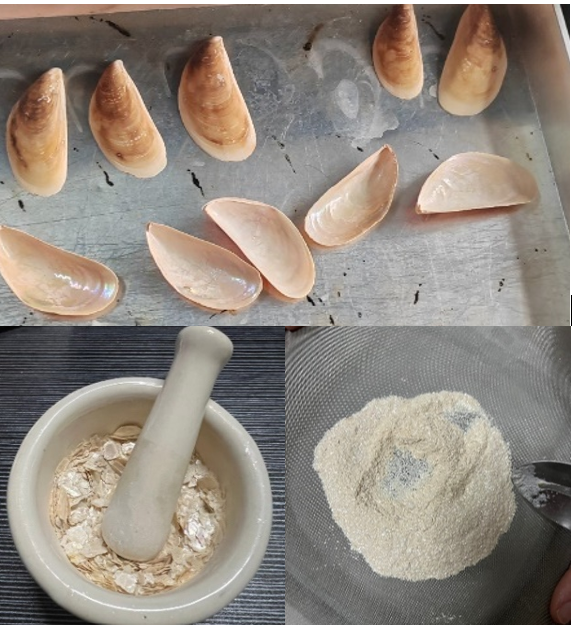
The purpose of this project is to study the optimal conditions to produce pearlescent powder from mussel shells in printing ink mixing. This study is an experimental study. By taking the discarded mussel shells in mixed sizes. The structure of the mussel shells was changed, and the conditions were adjusted for fine grinding, and it was mixed with media ink and tested for glitter visibility from the sample. Studies have shown that when mussel shells are soaked in potassium hydroxide. The optimal soaking period for deforming mussel shells is 6 days and baked in a dryer at 250 degrees Celsius. The duration is 60 minutes, respectively. When taking the mussel shells, grind them with a scoop and analyze the size of the pearlescent powder. It was found that pearl sparkling powder was between 8.246 and 58.078 micrometers, with the largest size of pearl sparkling powder being 16.81 micrometers. When the pearl sparkle powder was mixed with 3 types of medium printing inks, namely medium gravure ink (A), medium screen printing ink (B), and medium offset printing ink (C). It was found that the 10:2 ratio of 10:2 medium screen printing ink to pearlescent powder (B1) had the most optimal printing properties and was tested for glitter visibility from the sample. The combination of A3, B1 and B2 has a high level of visual acuity evaluation. The average values were 4.10, 4.10, and 3.90 respectively.
Article Details

This work is licensed under a Creative Commons Attribution-NonCommercial-NoDerivatives 4.0 International License.
References
ณัฐนี เอื้อประยูร, “การศึกษาผลของการใช้หมึกพิมพ์ล่องหน และหมึกพิมพ์ผงสีมุก บนสิ่งพิมพ์ปลอดปลอม,” วิทยานิพนธ์ วท.ม. (เทคโนโลยีการพิมพ์), มหาวิทยาลัยเทคโนโลยีพระจอมเกล้าธนบุรี, กรุงเทพฯ, 2551.
วิภารัตน์ ดีอ่อง. “วช. ลุยบีซีจีแปรรูปขยะเปลือกหอยเป็นสินทรัพย์,” [ออนไลน์] https://shorturl.asia/dDOPf. (เข้าถึงเมื่อ 10ตุลาคม 2567)
C. Lertvachirapaiboon, T. Parnklang, P. Pienpinijtham, K. Wongravee, C. Thammacharoen, & S. Ekgasit, "Selective colors reflection from stratified aragonite calcium carbonate plates of mollusk shells," Journal of Structural Biology, vol. 191, no. 2, pp. 184–189, 2015.
สำนักงานพัฒนาวิทยาศาสตร์และเทคโนโลยีแห่งชาติ. "แปรรูป ‘เปลือกหอย’ ขยะ อุตสาหกรรม สู่ ‘สารสำคัญเวชสำอาง พลาสติก กระดาษ’," [ออนไลน์] https://www.nstda.or.th/home /news_post/sci-update-bio-calcium-carbonate-fromshell/. (เข้าถึงเมื่อ 10ตุลาคม 2567)
เมธีรัตน์ ธานีรัตน์. “ครีมขัดผิวเพิ่มประสิทธิภาพด้วยเกล็ดประกายมุกจากเปลือกหอยแมลงภู่,” วิทยานิพนธ์ วท.ม. (ธุรกิจเทคโนโลยีและการจัดการนวัตกรรม), จุฬาลงกรณ์มหาวิทยาลัย, กรุงเทพฯ, 2564.
วัชราภรณ์ ภาณุพินทุ. “เกล็ดประกายมุกจากเปลือกหอยแมลงภู่ใช้ทดแทนกลิตเตอร์ในผลิตภัณฑ์สีนํ้าในงาน ศิลปะสําหรับเด็กปฐมวัย,” วิทยานิพนธ์ วท.ม. (ธุรกิจเทคโนโลยีและการจัดการนวัตกรรม), จุฬาลงกรณ์มหาวิทยาลัย, กรุงเทพฯ, 2566.
ศุภากร มั่งคั่ง. “นวัตกรรมการสร้างสรรค์ตราสินค้าเครื่องแต่งกายปาร์ตี้แวร์สำหรับกลุ่มเฟมบอย จากสีเกล็ดประกายมุกจากเปลือกเพอร์นา วิริดิส ด้วยแนวคิดสุนทรียศาสตร์แคมป์,” วิทยานิพนธ์ ศศ.ม. (นฤมิตรศิลป์), จุฬาลงกรณ์มหาวิทยาลัย, กรุงเทพฯ, 2565.
ธีระ ตั้งวิชาชาญ, ความรู้ทั่วไปเกี่ยวกับการพิมพ์, พิมพ์ฉบับปรับปรุงครั้งที่ 1, กรุงเทพฯ, มหาวิทยาลัยสุโขทัยธรรมาธิราช, 2548.
