Production of Pigments from Purple Potatoes for use in Screen Printing
Article Sidebar
Main Article Content
Abstract
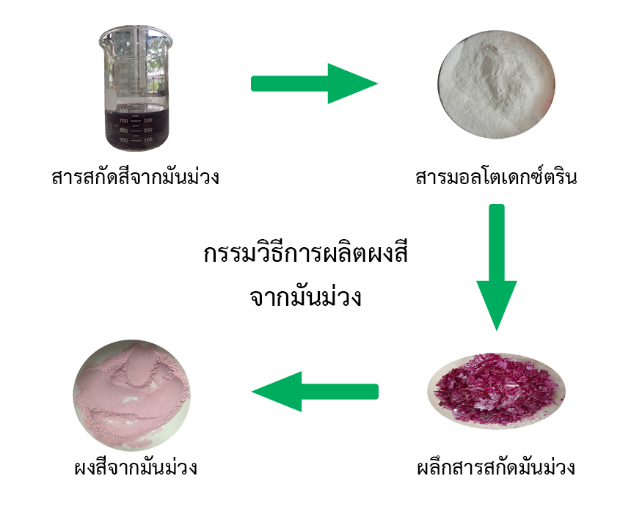
This research aims to study the production of purple sweet potato pigment powder for screen printing using the initial pigment extraction process, which involves extracting purple sweet potato with ethyl alcohol, adding maltodextrin to the resulting purple sweet potato extract to aid in color absorption, and then drying it. The dried extract is then ground into a powder and sieved thru a 400-mesh screen. Five different ratios of purple sweet potato pigment powder to medium were tested for screen printing ink. Screen printing was performed on white cotton fabric, and the printed fabric was measured for CIEL*a*b* color values to determine color difference. The results showed that the ratio of purple sweet potato pigment powder to medium at 40:60 yielded the best print color. The prints were then tested for color fastness to dry and wet rubbing, and color fastness to washing. The results of the dry rubbing color fastness test showed slight to no color bleeding. The wet rubbing color fastness test showed slight color bleeding. The washing color fastness test showed a slight change in color from the original. Therefore, it can be concluded that purple sweet potato can be used to produce pigment powder that yields a purple color when mixed with a medium and can be used as screen printing ink.
Article Details

This work is licensed under a Creative Commons Attribution-NonCommercial-NoDerivatives 4.0 International License.
References
ศูนย์วิจัยและพัฒนาการเกษตรพิจิตร, “วิจัยและพัฒนาการผลิตมันเทศ,” [ออนไลน์]. https:// www.doa.go.th/plan/wp-content/uploads/ 2021/04/171.1การคัดเลือกมันเทศอายุเก็บเกี่ยวสั้น.pdf. (สืบค้นวันที่ 11 มกราคม 2567).
บ้านพอเพียง เกษตรพอเพียง, “มันเทศ มันไทย. บ้านพอเพียง,” [ออนไลน์]. https://xn--72c9acray9etb 5a2i5d.blogspot.com/2016/12/sweet-potato.html (สืบค้นวันที่ 11 มกราคม 2567)
M. Yusuf, M., Shabbir, and F. Mohammad, “Natural colorants: Historical, processing and sustainable prospects,” Natural Products and Bioprospecting, vol. 7, no. 1, pp. 123–145, 2017.
S. Saikia, N. MahnotK, and C. L. Mahanta, “Optimisation of phenolic extraction from Averrhoa carambola pomace by response surface methodology and its microencapsulation by spray and freeze drying,” Food Chemistry, vol. 171, pp. 144–152, 2015.
บุญเสริม วัฒนกิจ, “สหบททางธรรมชาติ: รงควัตถุจากธรรมชาติโดยการบูรณาการภูมิปัญญาท้องถิ่นและเทคโนโลยีสะอาด สู่การสร้างสรรค์ทางศิลปศึกษา,”ดุษฎีนิพนธ์ ปร.ด. (ทัศนศิลป์และการออกแบบ), มหาวิทยาลัยบูรพา, ชลบุรี, 2559.
พบสันต์ ติไชย และอรนุ คำแปน, “การผลิตผงสีจากใบตะเคียนหนูสำหรับการพิมพ์สกรีนเพื่อเพิ่มมูลค่าผลิตภัณฑ์ผ้าทอน้ำมอญ,” วารสารชุมชนวิจัย, ปีที่ 10, ฉบับที่ 2, หน้า 99-106, พฤษภาคม-สิงหาคม 2559.
สุธิรา พลเจริญ, บวรนัต นพปศักดิ์, กฤตไชย พลินทรนันท์, สงกรานต์ จันทะรัง, พิญญ์พัชร์ ตรีฉิมพลี และนุวัฒน์ พรมจันทึก, กรมหม่อนไหม กระทรวงเกษตรและสหกรณ์. “การศึกษาผลของระดับของอุณหภูมิและชนิดของสารช่วยทำแห้งในการทำแห้งแบบพ่นฝอยในการผลิตผงสีผงจากใบหูกวาง,” [ออนไลน์]. https://qsds.go.th/newosrd/wp-content/uploads/sites/115/2021/06/19-Effect-of-Temperature-and-Drying-Aid-on-Spray-Drying-Tropical-Almond-Leaf.pdf. (สืบค้นวันที่ 10 กรกฎาคม 2567).
V. D. Truong, N., Deighton, R. L. Thompson, R. F. McFeeters, L. O. Dean, K. V Pecota, & G. C. Yencho. “Characterization of anthocyanins and anthocyanidins in purple-fleshed sweetpotatoes by HPLC-DAD/ESI-MS/MS,” Journal of Agricultural and Food Chemistry, vol. 58, no. 1, pp. 404–410, 2010.
D. Wannasin, L. Grossmann, and D.J. McClements, “Optimizing the Appearance of Plant-based Foods Using Natural Pigments and Color Matching Theory,” Food Biophysics, vol. 19, pp. 120–130, Sep. 2024.
วิธีทดสอบสิ่งทอ เล่ม 5 ความคงทนของสีต่อการขัดถู, สำนักงานมาตรฐานผลิตภัณฑ์อุตสาหกรรม, 2552 (5). วิธีทดสอบสิ่งทอ เล่ม 3 ความคงทนของสีต่อการซักด้วยสบู่หรือสบู่ และโซดา, สำนักงานมาตรฐานผลิตภัณฑ์อุตสาหกรรม, 2552 (3).
เนตรปรียา ทองไพบูลย์ และ ปทุมรัตน์ อุดมรัตนกุล, “การผลิตผงสีจากมันม่วงเพื่อใช้ในงานพิมพ์สกรีน,” วิทยานิพนธ์ วท.บ. (เทคโนโลยีการพิมพ์) มหาวิทยาลัยเทคโนโลยีราชมงคลกรุงเทพ, กรุงเทพฯ, 2567.
