การเปรียบเทียบปริมาณสารพฤกษเคมีและฤทธิ์ต้านอนุมูลอิสระของสารสกัดใบบัวบกและใบผักแว่นแก้ว
Article Sidebar
Main Article Content
บทคัดย่อ
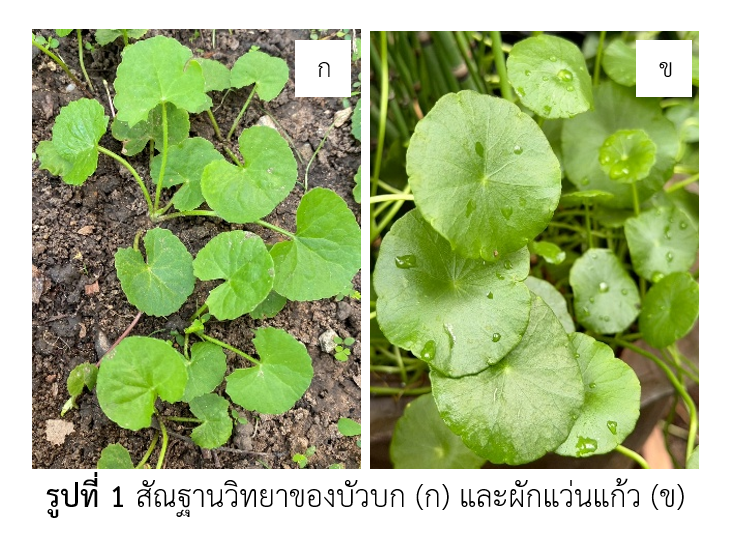
บัวบก (Centella asiatica) จัดเป็นพืชที่มีความสำคัญในทางการแพทย์ เนื่องจากสามารถบริโภคเพื่อป้องกันการเสื่อมถอยของระบบประสาท ลดระดับน้ำตาลในเลือด และอาจมีฤทธิ์ในการต้านอนุมูลอิสระและลดการอักเสบได้ อย่างไรก็ตามผู้บริโภคมักเกิดความสับสนระหว่างบัวบกกับผักแว่นแก้ว (Hydrocotyle umbellata) เนื่องจากพืชทั้งสองชนิดนี้มีลักษณะทางสัณฐานวิทยาคล้ายคลึงกัน งานวิจัยในครั้งนี้มีวัตถุประสงค์เพื่อศึกษาเปรียบเทียบปริมาณสารประกอบฟีนอลิกรวม ฟลาโวนอยด์รวม และฤทธิ์ต้านอนุมูลอิสระของสารสกัดจากใบบัวบกและใบผักแว่นแก้ว ด้วยวิธี DPPH รวมถึงการประเมินประสิทธิภาพของตัวทำละลาย ได้แก่ เอทานอลและเมทานอล ในการสกัดสารพฤกษเคมีจากใบบัวบกและใบผักแว่นแก้ว ผลการศึกษาพบว่าใบบัวบกมีปริมาณสารประกอบฟีนอลิกรวมสูงกว่าใบผักแว่นแก้ว โดยเอทานอลเป็นตัวทำละลายที่ให้ปริมาณสารประกอบฟีนอลิกสูงกว่าเมทานอล และใบบัวบกที่สกัดด้วยเอทานอลให้ปริมาณสารประกอบฟีนอลิกสูงที่สุด เท่ากับ 930.50 mg GAE/ g extract ในขณะที่ใบบัวบกที่สกัดด้วยเมทานอลมีปริมาณสารประกอบฟลาโวนอยด์รวมเท่ากับ 1,060.13 mg QE/ g extract ซึ่งสูงกว่าสารสกัดใบบัวบกที่สกัดด้วยเอทานอล แต่สารสกัดเอทานอลและเมทานอลของใบผักแว่นแก้วให้ปริมาณสารประกอบฟลาโวนอยด์รวมใกล้เคียงกัน และผลการเปรียบเทียบประสิทธิภาพของตัวทำละลายพบว่าเมทานอลเหมาะสมต่อการสกัดสารประกอบฟลาโวนอยด์มากกว่าเอทานอล เมื่อพิจารณาความสามารถในการต้านอนุมูลอิสระด้วยวิธี DPPH พบว่าใบบัวบกมีความสามารถในการต้านอนุมูลอิสระสูงกว่าใบผักแว่นแก้ว ในขณะที่การสกัดด้วยเมทานอลให้ประสิทธิภาพการสกัดสารต้านอนุมูลอิสระสูงกว่าการสกัดด้วยเอทานอล และใบบัวบกที่สกัดด้วยเมทานอลมีความสามารถในการต้านอนุมูลอิสระสูงที่สุดเมื่อเปรียบเทียบกับกลุ่มอื่น โดยมีค่า IC50 เท่ากับ 15.74 µg/mL งานวิจัยชิ้นนี้เป็นการแสดงให้เห็นความสำคัญในการจำแนกและเลือกใช้พืชให้ถูกชนิด รวมถึงการเลือกใช้ตัวทำละลายให้เหมาะสม ซึ่งอาจส่งผลต่อปริมาณสารพฤกษเคมีและฤทธิ์ทางชีวภาพที่เป็นประโยชน์ เพื่อก่อให้เกิดประสิทธิผลต่อผู้บริโภคสูงสุด
Article Details

อนุญาตภายใต้เงื่อนไข Creative Commons Attribution-NonCommercial-NoDerivatives 4.0 International License.
เอกสารอ้างอิง
G. Pizzino, N. Irrera, M. Cucinotta, G. Pallio, F. Mannino, V. Arcoraci, F. Squadrito, D. Altavilla, and A. Bitto, “Oxidative stress: Harms and benefits for human health,” Oxidative Medicine and Cellular Longevity, vol. 2017, no. 1, p. 8416763, Jan. 2017, doi: 10.1155/2017/8416763.
O. P.-C. Ugwu, M. N. Ugwu, F. C. Ogenyi, E. U. Alum, V. H. U. Eze, M. Basajja, J. N. Ugwu, M. B. Okon, C. N. Ugwu, C. N. Anyanwu, J. Obiezu, C. Ezeonwumelu, D. T. Swase, B. Samanya, S. I. Egba, D. E. Uti, and H. Onohuean, “Synergistic phytochemicals in multi-target drug discovery for complex diseases: A narrative review,” Phytomedicine Plus, vol. 6, no. 3, p. 100995, May 2026, doi: 10.1016/j.phyplu.2026.100995.
ระวิวรรณ เจริญทรัพย์, ธิดารัตน์ ดวงยอด, ธรากร มณีรัตน์, ปราวรี ภูนีรับ, สิรินันท์ สุวรรณาภรณ์, กวิตา เฟื่องฟู, ชาลินี จันต๊ะ, ชนม์นิภา สามารถ, และสุชิรา แสงจันทร์, จัดทำข้อเสนอเชิงนโยบาย การสร้างเสถียรภาพและความเข้มแข็งทางการค้า สินค้าสมุนไพร, นนทบุรี: สำนักงานนโยบายและยุทธศาสตร์การค้า, 2568.
คณะอนุกรรมการจัดทำตำราอ้างอิงยาสมุนไพรไทย, "ตำราอ้างอิงสมุนไพรไทย: บัวบก (BUABOK)," วารสารการแพทย์แผนไทยและการแพทย์ทางเลือก, ปีที่ 9, ฉบับที่ 1, หน้า 57-61, ม.ค.-ส.ค. 2554.
S. A. Hamdy, H. M. E. Hefnawy, S. M. Azzam, and E. A. Aboutabl, “Botanical and genetic characterization of Hydrocotyle umbellata L. cultivated in Egypt,” Bulletin of Faculty of Pharmacy Cairo University, vol. 56, no. 1, pp. 46–53, Apr. 2018, doi: 10.1016/j.bfopcu.2018.03.006.
L. Khwanchum, A. Intharuksa, S. Yanaso, and K. Thongkhao, “Differentiation of Centella asiatica (L.) Urb. from Hydrocotyle umbellata L. using the trnH-psbA region, species-specific bands and anisocytic stomata as markers for quality control of raw materials and their products,” Journal of Applied Research on Medicinal and Aromatic Plants, vol. 37, p. 100504, Jul. 2023, doi: 10.1016/j.jarmap.2023.100504.
B. Noppradit, P. Suklim, S. Nanarong, C. Leeratiwong, S. Laphookhieo, and P. Puttarak, “Exploring the immunomodulatory, anti-inflammatory, and cell proliferative potential of Hydrocotyle umbellata L. Leaf extracts: A comparative study with Centella asiatica (L.) Urb,” Phytomedicine Plus, vol. 6, no. 2, p. 100969, Feb. 2026, doi: 10.1016/j.phyplu.2026. 100969
P. Panomai, S. Thapphasaraphong, and N. Nualkaew, “A Comparative Study of Two Oroxylum indicum (L.) Kurz. Phenotypes Based on Phytochemicals and Antioxidant Effects, and the Anti-Inflammatory Activity of Leaf and Pod Extracts,” Plants, vol. 13, no. 15, p. 2110, Jul. 2024, doi: 10.3390/plants13152110.
J. Chen, J. Yang, L. Ma, J. Li, N. Shahzad, and C. K. Kim, “Structure-antioxidant activity relationship of methoxy, phenolic hydroxyl, and carboxylic acid groups of phenolic acids,” Scientific Reports, vol. 10, no. 1, p. 2611, Feb. 2020, doi: 10.1038/s41598-020-59451-z.
I. E. Orhan, “Centella asiatica (L.) Urban: From Traditional Medicine to Modern Medicine with Neuroprotective Potential,” Evidence-based Complementary and Alternative Medicine, vol. 2012, pp. 1–8, Jan. 2012, doi: 10.1155/2012/946259.
L. S. Singh and W. S. Singh, “Centella asiatica and its bioactive compounds: a comprehensive approach to managing hyperglycemia and associated disorders,” Discover Plants., vol. 1, no. 1, Dec. 2024, doi: 10.1007/s44372-024-00070-7.
J. Lim, K. Kim, D. Y. Kwon, J. K. Kim, R. Sathasivam, and S. U. Park, “Effects of Different Solvents on the Extraction of Phenolic and Flavonoid Compounds, and Antioxidant Activities, in Scutellaria baicalensis Hairy Roots,” Horticulturae, vol. 10, no. 2, p. 160, Feb. 2024, doi: 10.3390/horticulturae10020160.
O. P. Arya, I. D. Bhatt, and K. Mohanty, “Effect of different extraction solvents on bioactive phenolics and antioxidant potential of Illicium griffithii fruit,” Journal of Applied Research on Medicinal and Aromatic Plants, vol. 40, p. 100547, Apr. 2024, doi: 10.1016/j.jarmap.2024.100547.
E. A. Mohammed, I. G. Abdalla, M. A. Alfawaz, M. A. Mohammed, S. A. Al Maiman, M. A. Osman, A. E. A. Yagoub, and A. B. Hassan, “Effects of extraction solvents on the total phenolic content, total flavonoid content, and antioxidant activity in the aerial part of root vegetables,” Agriculture, vol. 12, no. 11, p. 1820, Oct. 2022, doi: 10.3390/agriculture12111820.
Z. Xiang, L. Liu, Z. Xu, Q. Kong, S. Feng, T. Chen, L. Zhou, H. Yang, Y. Xiao, and C. Ding, “Solvent Effects on the Phenolic Compounds and Antioxidant Activity Associated with Camellia polyodonta Flower Extracts,” ACS Omega, vol. 9, no. 25, pp. 27192–27203, Jun. 2024, doi: 10.1021/acsomega.4c01321.
R. E. Mutha, A. U. Tatiya, and S. J. Surana, “Flavonoids as natural phenolic compounds and their role in therapeutics: an overview,” Future Journal of Pharmaceutical Sciences, vol. 7, no. 1, p. 25, Jan. 2021, doi: 10.1186/s43094-020-00161-8.
P. Mohapatra, A. Ray, S. Jena, S. Nayak, and S. Mohanty, “Influence of extraction methods and solvent system on the chemical composition and antioxidant activity of Centella asiatica L. leaves,” Biocatalysis and Agricultural Biotechnology, vol. 33, p. 101971, Mar. 2021, doi: 10.1016/j.bcab.2021.101971.
A. K. Ibadullayeva, M. Kasela, K. K. Kozhanova, G. M. Kadyrbayeva, J. Widelski, K. Wojtanowski, A. Józefczyk, K. Susniak, P. Okinczyc, M. I. Tleubayeva, A. A. Karaubayeva, M. A. Zhandabayeva, A. Z. Mukhamedsadykova, and A. Malm, "Chemical profile and biological properties of methanolic and ethanolic extracts from the aerial parts of Inula britannica L. growing in Central Asia," Molecules, vol. 29, no. 23, p. 5749, 2024, doi: 10.3390/molecules29235749.
A. Mehmood, S. Javid, M. F. Khan, K. S. Ahmad, and A. Mustafa, “In vitro total phenolics, total flavonoids, antioxidant and antibacterial activities of selected medicinal plants using different solvent systems,” BMC Chemistry, vol. 16, no. 1, p. 64, Aug. 2022, doi: 10.1186/s13065-022-00858-2.
M. Platzer, S. Kiese, T. Herfellner, U. Schweiggert-Weisz, and P. Eisner, “How does the phenol structure influence the results of the Folin-Ciocalteu assay?,” Antioxidants, vol. 10, no. 5, p. 811, May 2021, doi: 10.3390/antiox10050811.
