
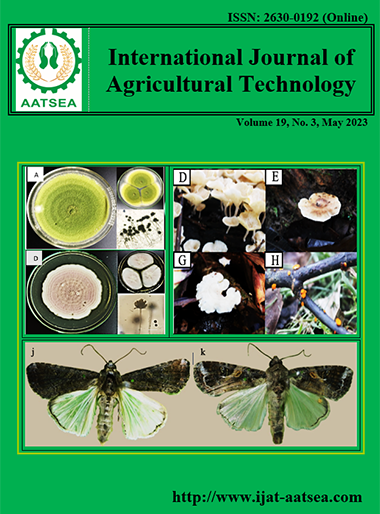
Characterization, molecular identification, and phylogenetic analysis of microfungi isolated from the Landfill Site of Bangar, La Union, Philippines
Article Sidebar
Main Article Content
Abstract
Ten indigenous microfungal species were characterized and identified belonging to four genera such as Actinomucor sp., Acrophialophora sp., Aspergillus candidus, A. flavus, A. fumigatus, A. niger, A. oryzae, A. terreus, and Penicillium oxalicum and Penicillium sp. Seven microfungal species were successfully sequenced, and phylogenetic analysis revealed monophyly in Aspergillus spp. while Acrophialophora sp. is distantly related to the other microfungal species. After establishing their biological information, their biofunctional potential can be explored
Article Details

This work is licensed under a Creative Commons Attribution-NonCommercial-NoDerivatives 4.0 International License.
References
Alwakeel, S. (2016.) Molecular identification of fungi isolated from coastal regions of Red Sea, Jeddah, Saudi Arabia. Journal of the Association of Arab Universities for Basic and Applied Sciences, 24. 10.1016/j.jaubas.2016.10.001.
Appiah, T., Agyare, C. and Luo, Y. (2017). Molecular Identification of Some Ghanaian Mushrooms Using Internal Transcribed Spacer Regions. Molecular Biology, 6:3.
Binkowska, A. G., Długonski, A., Bernat, P., Długonski, J. and Jasinska, A. (2022). Accelerated PAH Transformation in the Presence of Dye Industry Landfill Leachate Combined with Fungal Membrane Lipid Changes. International Journal of Environmental Research and Public Health, 19:1-19.
Chang, P. K., Ehrlich, K. C. and Hua, S. S. (2006). Cladal relatedness among Aspergillus oryzae isolates and Aspergillus flavus S and L morphotype isolates. International Journal of Food Microbiology, 25:108:172-7.
Cui, J., Wang, Y., Han, J. and Cai, B. (2015). Analyses of the community compositions of root rot pathogenic fungi in the soybean rhizosphere soil. Clean Journal of Agriculture Research, 76:172-7.
Dentinger, B. T. M., Didukh, M. Y. and Moncalvo, J. M. (2011). Comparing COI and ITS as DNA Barcode Markers for Mushrooms and Allies (Agaricomycotina). PLoS ONE, 6:9
Deshmukh, R., Khardenavis, A. A. and Purohit, H. J. (2016). Diverse Metabolic Capacities of Fungi for Bioremediation. Indian J Microbiol, 56:247-264.
Elbashiti, T., Fayyad, A. and Elkichaoui, A. (2010). Isolation and Identification of Aspergillus oryzae and the Production of Soy Sauce with New Aroma. Pakistan Journal of Nutrition, 9:1171-1175.
Ezeonuegbu, B. A., Abdullahi, M. D., Whong, C. M. Z., Sohunago, J. W., Kassem, H. S., Yaro, C. A., Hetta, H. F., Hedeab, G. M., Zouganelis, G. D. and Batiha, G. E. (2022). Characterization and phylogeny of fungi isolated from industrial wastewater using multiple genes. Scientific Reports, 12:2094.
Gautam, A. K. and Bhadauria, R. (2012). Characterization of Aspergillus species associated with commercially stored triphala powder. African Journal of Biotechnology, 11:16814-16823
Guan, Y. M., Deng, J. C., Ma, Y. Y., Li, Y. and Zhang, Y. Y. (2020). Seed Associated Fungal Diversity and the Molecular Identification of Fusarium with Potential Threat to Ginseng (Panax ginseng) in China. Plangts Disease, 104:330-339.
Hebert, P. D. N., Cywinska, A., Ball, S. L. and de Waard, J. R. (2002). Biological Identifications through DNA Barcodes. Proceedings of the Royal Society of London, B:270:313-321.
Hong, S. B., Kim, D. H., Park, I. C., Samson, R. A. and Shin, H. D. (2010). Isolation and Identification of Aspergillus section Fumigati Strains from Arable Soil in Korea. Mycobiology, 38:1-16.
Iravanian, A. and Ravari, S. O. (2020). Types of Contamination in Landfills and Effects on The Environment: A Review Study. IOP Conference Series: Earth and Environmental Science, 614.
Li, Q., Liu, J. and Gadd, G. M. (2020). Fungal bioremediation of soil co-contaminated with petroleum hydrocarbons and toxic metals. Applied Microbiology and Biotechnology, 104:8999-9008.
Lira, M. M. A., Bernal, S. P. F., Castro, C. C. J., Ramos, P. M. M., Lira, M. J. S., Ottoni, J. R., Boroski, M. and Passarini, M. R. Z. (2022). Plant regeneration through somatic embryogenesis from stem and petiole explant of chicory (Cichorium intybus L). Indian Journal of Biotechnology, 6:250-255.
McClenny, N. (2005). Laboratory detection and identification of Aspergillus species by microscopic observation and culture: the traditional approach, Medical Mycology, 43:S125-S128.
Miyazima, S. and Matsuura, S. (2011). Morphology of the Fungus Aspergillus oryzae and nidulans. MRS Online Proceeding Library Archive. https://www.researchgate.net/publication/269616771
Nair, A. T. (2021). Bioaerosols in the landfill environment: an overview of microbial diversity and potential health hazards. Aerobiologia, 37:185-203.
Ozyurek, S. B., Avcioglu, N. H. and Bilkay, I. S. (2021). Mycoremediation potential of Aspergillus ochraceus NRRL 3174. Archives of Microbiology, 203:5937-5950.
Raja, H. A., Miller, A. N., Pearce, C. J. and Oberlie, N. H. (2019). Fungal Identification Using Molecular Tools: A Primer for the Natural Products Research Community. Journal of Natural Products, 80:756-770.
Rajaratnam, S. and Thiagarajan, T. (2012). Molecular characterization of wild mushroom. European Journal of Experimental Biology, 2:369-373.
Ram, R. C., Pandey, V. N. and Singh, H. B. (2010). Morphological Characterization of Edible Fleshy Fungi From Different Forest Regions. Indian Journal of Scientific Research, 1:33-35.
Roy, S., Sourav, D. and Rakhi, B. A. (2014). A Review on Phylogenetic Analysis: A Journey through Modern Era. Computational Molecular Bioscience, 04:39-45.
Schoch, C. L., Seifert, K. A., Huhndorf, S., Robert, V., Spouge, J. L., Levesque, C. A. and Chen, W. (2012). Nuclear Ribosomal Internal Transcribed Spacer (ITS) Region as a Universal DNA Barcode Marker for Fungi. PNAS, 109:6241-6246.
Singh, K., Frisvad, J. C., Thrane, U. and Mathur, S. B. (1991). An Illustrated Manual on Identification of some Seed-borne Aspergilli, Fusaria, Penicillium and their Mycotoxins.1st (Ed.). AiO Tryk. Odense, Denmark. ISBN, 87-7026-3175.
Thathana, M., Murage, H., Abia, A. and Pillay, M. (2017). Morphological Characterization and Determination of Aflatoxin-Production Potentials of Aspergillus flavus Isolated from Maize and Soil in Kenya. Agriculture, 7. 80. 10.3390/agriculture7100080.
Verma, N. and Gupta, S. (2019). Assessment of LDPE degrading potential Aspergillus species isolated from municipal landfill sites of Agra. SN Applied Sciences, 1:701.
Zeng, Q., Lv, Y., Xu, X., Deng, Y., Wang, F., Liu, S., Liu, L., Yang, C. and Liu, Y. (2022). Morpho-Molecular Characterization of Microfungi Associated with Phyllostachys (Poaceae) in Sichuan, China. Journal of Fungi, 8:1-39.
