
Assessing genetic diversity of Yellow Star tree using SRAP markers and efficacy of their endophytic fungi in biological control
Article Sidebar
Main Article Content
Abstract
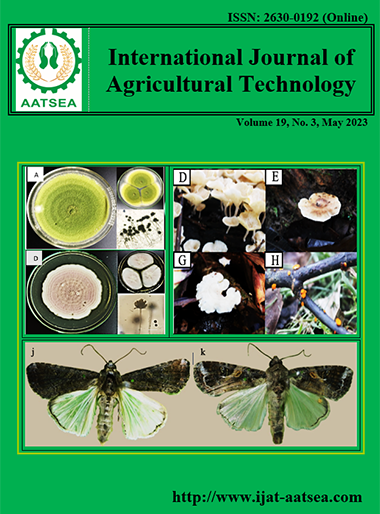
The result showed that 52 fragments (64.22%) were polymorphic bands from seven combinations of Sequence-Related Amplified Polymorphism (SRAP) markers. The genetic relationship was analyzed using the UPGMA method by NTSYpc software version 2.11X showed a similarity coefficient ranging from 0.59 to 0.98. Endophytic fungi were isolated from fresh leaves of Yellow Star (Schoutenia glomerata King subsp. peregrina (Craib) Roekm. & Hartono and identified by morphology and DNA barcoding. The fungi were identified in Alternaria alternata, Colletotrichum siamense, Diaporthe arengae, Phyllosticta capitalensis, and Xylaria cubensis. The dual culture test evaluated the efficacy of endophytic fungi isolated from Yellow Star tree against Colletotrichum gloeosporioides and Phomopsis asparagi causing disease in asparagus. The results revealed that X. cubensis had the potential to inhibit the spore germination of the C. gloeosporioides ASGC06 and P. asparagi ASGP04, which inhibited spore germination of 99.97 and 100 percent, respectively. However, this fungus should be further studied for biological control and bioactive secondary metabolites.
Article Details

This work is licensed under a Creative Commons Attribution-NonCommercial-NoDerivatives 4.0 International License.
References
Azizov, U. M., Mirakilova, D. B., Umarova, N. T., Salikhov, S. A., Rakhimov, D. A. and Mezhlumyan, L. G. (2007). Chemical composition of dry extracts from Alcea rosea. Chemistry of Natural Compounds, 43:508-511.
Badrkhani, N., Rahmani, F. and Larti, M. (2014). Evaluation of genetic diversity in Alcea (Malvaceae) using SRAP markers. Botanical Sciences, 92:433-439.
Casas, L. L., Pereira, J. O., Costa-Neto, P. Q., Silva, J. F., Almeida, L. N., Bianco, R. A. and Azevedo, J. L. (2021). Endophytic Colletotrichum siamense for biocontrol and resistance induction in guarana seedlings. International Journal of Microbiology ID 1925226.
DeMers, M. (2022). Alternaria alternata as endophyte and pathogen. Microbiology, 168:001153.
Dong, Z., Manawasinghe, I. S., Huang, Y., Shu, Y., Phillips, A. J., Dissanayake, A. J., Hyde, K. D., Xiang, M. and Luo, M. (2021). Endophytic Diaporthe associated with Citrus grandis cv. tomentosa in China. Frontiers in Microbiology, 11:609387.
Doyle, J. J. and Doyle, J. L. (1990). Isolation of plant DNA from fresh tissue. Focus, 12:13-15.
Glienke, C., Pereira, O. L., Stringari, D., Fabris, J., Kava-Cordeiro, V., Galli-Terasawa, L., Cunnington, J., Shivas, R. G., Groenewald, J. Z., and Crous, P. W. (2011). Endophytic and pathogenic Phyllosticta species, with reference to those associated with citrus black spot. Persoonia, 26:47-56.
Gomes, R. R., Glienke, C., Videira, S. I., Lombard, L., Groenewald, J. Z. and Crous, P. W. (2013). Diaporthe: a genus of endophytic, saprobic and plant pathogenic fungi. Persoonia, 31:1-41.
Klaiklay, S., Rukachaisirikul, V., Sukpondma, Y., Phongpaichit, S., Buatong, J. and Bussaban, B. (2012). Metabolites from the mangrove-derived fungus Xylaria cubensis PSU-MA34. Archives of Pharmacal Research, 35:1127-1131.
Li, G., and Quiros, C. F. (2001). Sequence-related amplified polymorphism (SRAP), a new marker system based on a simple PCR reaction: its application to mapping and gene tagging in Brassica. Theoretical and Applied Genetics, 103:455-461.
Lio, D. D., Cobo, J. F., Masson, C., Chalopin, M., Kebe, D., Giraud, M., Verhaeghe, A., Nodet, P., Sarrocco, S., Floch, G.L. and Baroncelli, R. (2018). Combined metabarcoding and multi-locus approach for genetic characterization of Colletotrichum species associated with common walnut (Juglans regia) anthracnose in France. Scientific Reports 8(1): 10765.
Ma, X., Nontachaiyapoom, S., Jayawardena, R. S., Hyde, K. D., Gentekaki, E. and Zhou, S. (2018). Endophytic Colletotrichum species from Dendrobium spp. in China and Northern Thailand. MycoKeys, 43:23-57.
Mamat, S., Shah, U. K. M., Remli, N. A. M., Shaari, K., Laboh, R. and Rahman, N. A. A. (2018). Characterization of antifungal activity of endophytic Penicillium oxalicum T3.3 for anthracnose biocontrol in dragon fruit (Hylocereus sp). International Journal of Environmental and Agriculture Research, 4:65-76.
Mangkalad, T., Soytong, K., Tangthirasunun, N. and Poeaim, S. (2018). Effective of Neosatorya to control Phomopsis asparagi causing stem blight of asparagus. International Journal of Agricultural Technology, 14:1423-1432.
Nonaka, K., Iwatsuki, M., Horiuchi, S., Shiomi, K., Omura, S., and Masuma, R. (2015). Induced production of BE-31405 by co-culturing of Talaromyces siamensis FKA-61 with a variety of fungal strains. The Journal of Antibiotics, 68:573-578.
Patil, M., Patil, R., Mohammad, S. and Maheshwari, V. (2017). Bioactivities of phenolics-rich fraction from Diaporthe arengae TATW2, an endophytic fungus from Terminalia arjuna (Roxb.). Biocatalysis and Agricultural Biotechnology, 10:396-402.
Qiang, S., Zhu, Y. Z., Summerell, B. A. and Li, Y. (2006). Mycelium of Alternaria alternata as a potential biological control agent for Eupatorium adenophorum. Biocontrol Science and Technology, 16:653-668.
Sabpayakom, N., Poeaim, A., Vanijajiva, O. and Poeaim, S. (2016). An efficient protocol for genomic DNA extraction from Santol (Sandoricum koetjape) for SRAP marker analysis. International Journal of Agricultural Technology, 12:1473-1480.
Sawadsitang, S., Mongkolthanaruk, W., Suwannasai, N. and Sodngam, S. (2015). Antimalarial and cytotoxic constituents of Xylaria cf. cubensis PK108. Natural Product Research, 29: 2033-2036.
Srikanlayanukul, M. and Silapawattana, P. (2022). Study of optimal extraction conditions and antioxidant activity of Schoutenia glomerata King subsp. peregrina (Craib) Roekm leaves and flowers. Thai Science and Technology Journal, 30:90-99.
Suksiri, S., Laipasu, P., Soytong, K. and Poeaim, S. (2018). Isolation and identification of Phytophthora sp. and Pythium sp. from durian orchard in Chumphon province, Thailand. International Journal of Agricultural Technology, 14:389-402.
Tran, N. T., Miles, A. K., Dietzgen, R. G. and Drenth, A. (2019). Phyllosticta capitalensis and P. paracapitalensis are endophytic fungi that show potential to inhibit pathogenic P. citricarpa on citrus. Australasian Plant Pathology, 48:281-296.
Thinhuatoey, N., Poeaim, S., Poeaim, A., Youryon, P. and Vanijajiva, O. (2016). Screening primers of SRAP markers for identify durian cultivars (Durio zibethinus). Agricultural Science Journal, 47:61-64.
Wikee, S., Lombard, L., Crous, P.W., Nakashima, C., Motohashi, K., Chukeatirote, E., Alias, S. A., McKenzie, E. H. C. and Hyde, K. D. (2013). Phyllosticta capitalensis, a widespread endophyte of plants. Fungal Diversity, 60:91-105.
Zakaria, L. and Aziz, W. N. W. (2018). Molecular identification of endophytic fungi from banana leaves (Musa spp.). Tropical Life Sciences Research, 29:201-211.
Zakaria, L. (2021). Diversity of Colletotrichum species associated with anthracnose disease in tropical fruit crops-a review. Agriculture, 11:297.
Zheng, H., Yu, Z., Jiang, X., Fang, L. and Qiao, M. (2022). Endophytic Colletotrichum species from aquatic plants in Southwest China. Journal of Fungi, 8:87.
