
Neuroprotective potential of polysaccharides from the mycelial extract of Schizophyllum commune
Article Sidebar
Main Article Content
Abstract
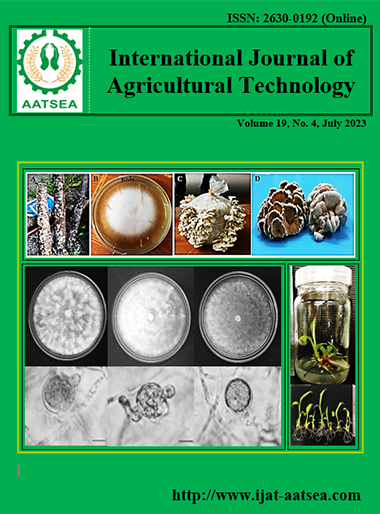
The fruiting body of split gill macrofungus was collected and isolated. Its ribosomal RNA (rRNA) gene was sequenced to identify the species. Based on ITS1 and ITS4 regions, the nucleotide sequence was matched with S. commune showing 99.89% identity. Moreover, to prepare the crude polysaccharide (CP) from mycelium, the pressurized hot water extraction method and ethanol precipitation were utilized. The neuroprotective activity was evaluated by applying 100 µM H2O2-induced oxidative stress on the SH-SY5Y cell line. Cell morphology was observed by fluorescent microscopy using Hoechst 33342 staining. A 250 µg/ml crude polysaccharide concentration reduced intracellular nuclear deformation compared to H2O2 alone with apoptosis protection of cells stained with Annexin-V and propidium iodide (PI). The cell cycle was estimated by PI staining and flow cytometry. The results showed that 125-250 µg/ml of crude polysaccharide reduced neuronal apoptosis. Furthermore, the crude polysaccharide mechanism of action reduced apoptosis in the sub-G1 phase compared to the H2O2 group. This is the first report on the neuroprotective effect of crude polysaccharides extracted from S. commune performed in vitro on the SH-SY5Y cell line.
Article Details

This work is licensed under a Creative Commons Attribution-NonCommercial-NoDerivatives 4.0 International License.
References
Adejoye, O. D., Adebayo-Tayo, B. C., Ogunjobi, A. A. and Afolabi, O. O. (2007). Physicochemical studies on Schizophyllum commune (Fries), a Nigerian edible fungus. World Applied Sciences Journal, 2:73-76.
Aguirre-Moreno, A., Campos-Pena, V., del Rio-Portilla, F., Herrera-Ruiz, M., Leon-Rivera, I., Montiel-Arcos, E. and Villeda-Hernandez, J. (2013). Anticonvulsant and neuroprotective effects of oligosaccharides from Lingzhi or Reishi medicinal mushroom, Ganoderma lucidum (Higher Basidiomycetes). International Journal of Medicinal Mushrooms, 15:555-568.
Chen, H., Zhang, J., Ren, J., Wang, W., Xiong, W., Zhang, Y. and Liu, H. (2018). Triterpenes and meroterpenes with neuroprotective effects from Ganoderma leucocontextum. Chemistry & Biodiversity, 15:1-9.
Chen, Z. G., Bishop, K. S., Zhang, J. and Quek, S. Y. (2022). Neuroprotective and Anticarcinogenic Properties of Hericium Mushrooms and the Active Constituents Associated with These Effects: A Review. Food Science and Engineering, 3:69-90.
Deng, Y., Huang, Q., Hu, L., Liu, T., Zheng, B., Lu, D. and Zhou, L. (2021). Enhanced exopolysaccharide yield and antioxidant activities of Schizophyllum commune fermented products by the addition of Radix Puerariae. RSC advances, 11:38219-38234.
Du, B., Yang, Y., Bian, Z. and Xu, B. (2017). Characterization and anti-Inflammatory potential of an exopolysaccharide from submerged mycelial culture of Schizophyllum commune. Frontiers in Pharmacology, 8:1-11.
Dubois, M., Gilles, K. A., Hamilton, J. K., Rebers, P. T. and Smith, F. (1956). Colorimetric method for determination of sugars and related substances. Analytical chemistry, 28:350-356.
Friedman, M. (2016). Mushroom polysaccharides: chemistry and antiobesity, antidiabetes, anticancer, and antibiotic properties in cells, rodents, and humans. Foods, 5:80.
Garcia, R., La Clair, J. J. and Müller, R. (2018). Future directions of marine myxobacterial natural product discovery inferred from metagenomics. Marine Drugs, 16:303.
Han, C. H., Liu, Q. H., Ng, T. B. And Wang, H. X. (2005). A novel homodimeric lactose-binding lectin from the edible split gill medicinal mushroom Schizophyllum commune. Biochemical and biophysical research communications, 336:252-257.
Hobbs, C. (2005). The chemistry, nutritional value, immunopharmacology, and safety of the traditional food of medicinal split-gill fungus Schizophyllum commune Fr.:Fr. (Schizophyllaceae). A literature review. International Journal of Medicinal Mushrooms, 7:127-139.
Hou, Y., Dan, X., Babbar, M., Wei, Y., Hasselbalch, S. G., Croteau, D. L. and Bohr, V. A. (2019). Aging as a risk factor for neurodegenerative disease. Nature Reviews Neurology, 15:565-581.
Hung, C. W., Chen, Y. C., Hsieh, W. L., Chiou, S. H. and Kao, C. L. (2010). Aging and neurodegenerative diseases. Ageing Research Reviews, 9:36-46.
Kittimongkolsuk, P., Pattarachotanant, N., Chuchawankul, S., Wink, M. and Tencomnao, T. (2021). Neuroprotective effects of extracts from tiger milk mushroom Lignosus rhinocerus against glutamate-induced toxicity in ht22 hippocampal neuronal cells and neurodegenerative diseases in Caenorhabditis elegans. Biology, 10:30.
Kovacs, G. G. (2016). Molecular pathological classification of neurodegenerative diseases: turning towards precision medicine. International Journal of Molecular Sciences, 17:189.
Kovacs, G. G., Adle-Biassette, H., Milenkovic, I., Cipriani, S., Van Scheppingen, J. and Aronica, E. (2014). Linking pathways in the developing and aging brain with neurodegeneration. Neuroscience, 269:152-172.
Lee, I. K., Yun, B. S., Kim, J. P., Ryoo, I. J., Kim, Y. H. and Yoo, I. D. (2003). Neuroprotective activity of p-terphenyl leucomentins from the mushroom Paxillus panuoides. Bioscience, Biotechnology, and Biochemistry, 67:1813-1816.
Lee, I. K., Yun, B. S., Kim, Y. H. and Yoo, I. D. (2002). Two neuroprotective compounds from mushroom Daldinia concentrica. Journal of Microbiology and Biotechnology, 12:692-694.
Lemieszek, M. K., Nunes, F. M., Cardoso, C., Marques, G. and Rzeski, W. (2018). Neuroprotective properties of Cantharellus cibarius polysaccharide fractions in different in vitro models of neurodegeneration. Carbohydrate Polymers, 197:598-607.
Lin, M. T. and Beal, M. F. (2006). Mitochondrial dysfunction and oxidative stress in neurodegenerative diseases. Nature, 443:787-795.
Liu, C., Choia, M. W., Li, X. and Cheung, P. C. K. (2018). Immunomodulatory effect of structurally-characterized mushroom sclerotial polysaccharides isolated from Polyporus rhinocerus on human monoctyes THP-1. Journal of Functional Foods, 41:90-99.
Lutz, M. I., Milenkovic, I., Regelsberger, G. and Kovacs, G. G. (2014). Distinct patterns of sirtuin expression during progression of Alzheimer’s disease. Neuromolecular Medicine, 16:405-414.
Mansoldo, F. R. P., da Silva Cardoso, V., Junior, A. N., Cedrola, S. M. L., Maricato, V., Maria do Socorro, S. R. and Vermelho, A. B. (2020). Quantification of schizophyllan directly from the fermented broth by ATR-FTIR and PLS regression. Analytical Methods, 12:5468-5475.
Mohammadi, A., Shojaosadati, S. A., Tehrani, H. J., Mousavi, S. M., Saleh, T. and Khorasani, A. C. (2018). Schizophyllan production by newly isolated fungus Schizophyllum commune IBRC-M 30213: optimization of culture medium using response surface methodology. Annals of microbiology, 68:47-62.
Nik Ubaidillah, N. H., Abdullah, N. and Sabaratnam, V. (2015). Isolation of the intracellular and extracellular polysaccharides of Ganoderma neojaponicum (Imazeki) and characterization of their immunomodulatory properties. Electronic Journal of Biotechnology, 18:188-195.
Ooi, V. E. C. and Liu, F. (1999). A review of pharmacological activities of mushroom polysaccharides. International Journal of Medicinal Mushrooms, 1:195-206.
Przedborski, S., Vila, M. and Jackson-Lewis, V. (2003). Neurodegeneration: what is it and where are we?. Journal of Clinical Investigation, 111:3-10.
Sam, S. E., Sim, K. S., Rahman, S. N. S. A. and Tan, Y. S. (2022). Neuroprotective Properties of Wild Medicinal Mushroom, Sanguinoderma rugosum (Agaricomycetes), Extracts against Glutamate-Induced Hippocampal Cells. International Journal of Medicinal Mushrooms, 24:35-50.
Singh, M. K., Kumar, M. and Thakur, I. S. (2017). Proteomic characterization and schizophyllan production by Schizophyllum commune ISTL04 cultured on Leucaena leucocephala wood under submerged fermentation. Bioresource technology, 236:29-36.
Siripong, P., Rassamee, K., Piyaviriyakul, S., Yahuafai, J. and Kanokmedhakul, K. (2012). Anti-metastatic effects on B16F10 melanoma cells of extracts and two prenylated xanthones isolated from Maclura amboinensis Bl. roots. Asian Pacific Journal of Cancer Prevention, 13:3519-3528.
Su, C. H., Lai, M. N., Lin, C. C. and Ng, L. T. (2016). Comparative characterization of physicochemical properties and bioactivities of polysaccharides from selected medicinal mushrooms. Applied microbiology and biotechnology, 100:4385-4393.
Yoshiba, K., Sato, T., Osumi, T., Ulset, A. S. T. and Christensen, B. E. (2015). Conformation of carboxylated schizophyllan in aqueous solution. Carbohydrate polymers, 134:1-5.
Zhong, K., Tong, L., Liu, L., Zhou, X., Liu, X., Zhang, Q. and Zhou, S. (2015). Immunoregulatory and antitumor activity of schizophyllan under ultrasonic treatment. International Journal of Biological Macromolecule, 80:302-308.
Zhou, B., Fu, Q., Song, S., Zheng, H. and Wei, Y. (2015). Inhibitory effect of schizophyllan on rat glioma cells. Bangladesh Journal of Pharmacology, 10:759-764.
