
The effect of BA on inducing shoots of Philodendron erubescent ‘Pink Princes’ in vitro
Article Sidebar
Main Article Content
Abstract
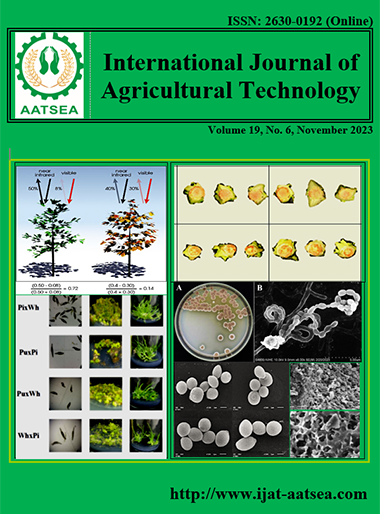
The study investigated the influence of plant growth regulator on the induction of direct shoots from node explants of Philodendron erubescens 'Pink Princes' in vitro condition. The result showed that the most of width, length, and height was observed in MS + BA 0.5 mg/l, measuring 3.40 cm × 3.22 cm × 1.96 cm and 1.74 g fresh weight. The highest number of shoots was consistently observed 60.44 shoots per nodal MDA content (1.91 nmol/g FW) and phenolic content (9.51 mg GAE/g FW) are lowest. The explant was cultured on MS medium performed highest chlorophyll content (chl A 213.96 mg/g FW, chl B 162.54 mg/ FW, total chlorophyll 304.64 mg/FW) and carotenoid content (2.61 mg/g FW) Moreover, they were the largest plant with green leaves when compared to another treatment.
Article Details

This work is licensed under a Creative Commons Attribution-NonCommercial-NoDerivatives 4.0 International License.
References
Akram, M. and Aftab, F. (2015). Effect of cytokinins on in vitro seed germination and changes in chlorophyll and soluble protein contents of teak (Tectona grandis L.). Biochemistry & Physiology, 4.
Alawaadh, A. A., Dewir, Y. H., Alwihibi, M. S., Aldubai, A. A., El-Hendawy, S. and Naidoo, Y. (2020). Micropropagation of Lacy Tree Philodendron (Philodendron bipinnatifidum Schott ex Endl.). HortScience, 55:294-299.
Boo, H. O., Heo, B. G., Gorinstein, S. and Chon S. U. (2011). Positive effects of temperature and growth conditions on enzymatic and antioxidant status in lettuce plants. Plant Science, 181:479-484.
Boyce, P. and Croat, T. B. (2013). The Überlist of Araceae, Totals for published and estimated number of species in aroid genera. Retrieved from. http://www.aroid.org/genera/130307uberlist.pdf
Chen, F. C., Wang, C. Y. and Fang, J. Y. (2012). Micropropagation of self-heading philodendron via direct shoot regeneration. Scientia Horticulturae, 141:23-29.
Cortleven, A. and Schmülling, T. (2015). Regulation of chloroplast development and function by cytokinin. Journal of Experimental Botany, 66:4999-5013.
Croat T. B. (1997). A revision of philodendron subgenus philodendron (araceae) for mexico and central america. Annals of the Missouri Botanical Garden 84:311.
Ebrahimzadeh, M. A., Nabavi, S. M. and Nabavi, S. F. (2009). Correlation between the in vitro iron chelating activity and poly phenol and flavonoid contents of some medicinal plants. Pakistan Journal of Biological Sciences, 12:934-938.
Fahmy, G. E., Arafa, A. M. S., Ibrahim, I. A. and Zaynab, E. Z. (1998). In vitro propagation of Philodendron erubescens cv. red emerald. Annals of Agricultural Science, 36:1635-1666.
Gomez, K. A. and Gomez, A. A. (1984). Statistical Procedures for Agricultural Research. 2nd Edition, John Wiley and Sons, New York, pp. 207-215.
Han, B. H. and Park, B. M. (2008). In vitro micropropagation of Philodendron cannifolium. The Korean Society of Plant Biotechnology, 35:203-208.
Hartman, R. D. (1974). Dasheen mosaic virus and other phytopathogens eliminated from caladium, taro, and cocoyam by culture of shoot tips. Phytopathology, 64:237-240.
Heath, R. L. and Packer, L. (1968). Photo peroxidation in isolated chloroplasts. Archives of Biochemistry and Biophysics, 125:189-198.
Henley, R. W., Chase, A. R. and Osborne, L. S. (2005). Philodendrons - self-heading types. CFREC-A Foliage Plant Research Note RH-91-27.
Henny, R. J. (1988). Ornamental aroids: culture and breeding. Horticultural Reviews, 10:1-26.
Jámborné Benczúr, E. and Márta-Riffer, A. (1990). In vitro propagation of Philodendron tuxlanum bunting with benzylaminopurine. Acta Agronomica Hungarica, 39:341-348.
Janků, M., Luhová, L. and Petřivalský, M. (2019). On the origin and fate of reactive oxygen species in plant cell compartments. Antioxidants, 8:105.
Lennarz, W. J. and Daniel Lane, M. (2013). Encyclopedia of biological chemistry, 2nd Edition. Elsevier, Amsterdam.
Lichtenthaler, H. K. and Buschmann, C. (2001). Chlorophylls and carotenoids: measurement and characterization by uv-vis spectroscopy. Current Protocols in Food Analytical Chemistry 1:F4.3.1-F4.3.8.
Mayo, S. J., Bogner, J., Catherine, E., Boyce, P. and Botanic, R. (1997). The genera of Araceae. Royal Botanic Gardens. pp.2-12.
Mehbub, H., Akter, A., Akter, Mst. A., Mandal, M. S. H., Hoque, Md. A., Tuleja, M. and Mehraj, H. (2022). Tissue culture in ornamentals: cultivation factors, propagation techniques, and its application. Plants, 11:3208.
Morales, M. and Munné-Bosch, S. (2019). Malondialdehyde: facts and artifacts. Plant Physiology, 180:1246-1250.
Murashige, T. and Skoog, F. (1962). A revised medium for rapid growth and bioassays with tobacco tissue cultures. Physiologia Plantarum 15:473-497.
Nowakowska, K., Pińkowska, A., Siedlecka, E. M. and Pacholczak, A. (2021). The effect of cytokinins on shoot proliferation, biochemical changes and genetic stability of rhododendron ‘kazimierz odnowiciel’ in the in vitro cultures. Journal of Plant Biotechnology, 149:675-684.
Reffstrup, T. and Boll, P. M. (1985). Allergenic 5-alkolyl and 5-alkenyl-resorcinals from philodendron species. Phytochemistry, 24:2563-2565.
Soobrattee, M. A., Neergheen, V. S., Luximon-Ramma, A., Aruoma, O. I. and Bahorun, T. (2005). Phenolics as potential antioxidant therapeutic agents: mechanism and actions. Mutation research, 579:200-13.
Sosnowski, J., Truba, M. and Vasileva, V. (2023). The impact of auxin and cytokinin on the growth and development of selected crops. Agriculture, 13:724.
Srivastava, L. M. (2002). Plant growth and development: hormones and environment. Academic Press, Amsterdam; Boston
Tulkova, Е. and Kabashnikova, L. (2021). Malondialdehyde content in the leaves of small-leaved linden tilia cordata and Norway maple acer platanoides under the influence of volatile organic compounds. Plant Biosystems - An International Journal Dealing with all Aspects of Plant Biology, 156:619-627.
