
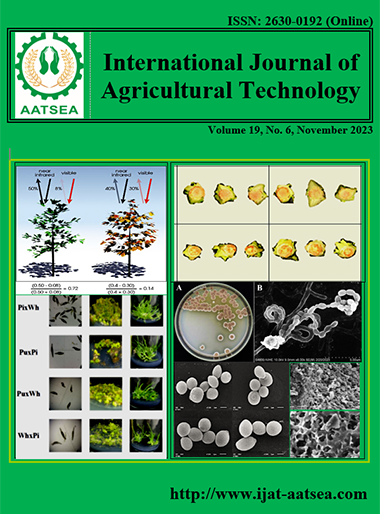
Production of F1 Papilionanthe hookeriana (Rchb.f.) Schltr. homozygous and heterozygous: Amplified fragment length polymorphism (AFLP) analysis of flower colors and self and cross-pollination ability between different flower colors
Article Sidebar
Main Article Content
Abstract
Results showed that seed germination of Papilionanthe hookeriana (Rchb.f.) Schltr. was not significantly different between self-pollination treatments, while the percentage of self-pollination ability and seedling numbers were significantly different at 0.01 and 0.05 levels, respectively. Pink and purple flowers had the highest self-pollination ability at 100% and the highest numbers of seedlings (1,295) for self-pollination of pink flowers. Percentages of cross-pollination ability, pod size and weight, and seed weight were not significantly different between treatments, while percentages of seed germination and seedling numbers were significantly different at the 0.01 level. The PixPu hybrid showed 100% seed germination, whereas the PixWh hybrid yielded the highest number of seedlings (403.2). Amplified fragment length polymorphism (AFLP) technique was used to study the genetic relations between various flower colors of P. hookeriana (Rchb.f.) Schltr. and the F1 hybrids of self- and cross-pollinated plants were classified into two clusters by UPGMA methods.
Article Details

This work is licensed under a Creative Commons Attribution-NonCommercial-NoDerivatives 4.0 International License.
References
Benner, M. S., Braunstein, M. D. and Weisberg, M. U. (1995). Detection of DNA polymorphisms within the genus Cattleya (Orchidaceae). Plant Molecular Biology Reporter, 13:147-155.
Borba, E. L. and Semir, J. (1999). Temporal variation in pollinarium size after its removal in species of Bulbophyllum: a different mechanism preventing self-pollination in Orchidaceae. Plant Systematics and Evolution, 217:197-204.
Cervera, M. T., Gusmao, J., Steenackers, M., Peleman, J., Storme, V., Broeck, A. V., Montagu, M. V. and Boerjan, W. (1996). Identification of AFLP molecular markers for resistance against Melampsora larici-populina in Populus. Theoretical and Applied Genetics, 93: 733-737.
Chen, X., Guan, J., Ding, R., Zhang, Q., Ling, X., Qu, B. and Zhang, L. (2013). Conservation genetics of the endangered terrestrial orchid Liparis japonica in Northeast China based on AFLP markers. Plant Systematics and Evolution, 299: 691-698.
Christenhusz, M. J. and Byng, J. W. (2016). The number of known plants species in the world and its annual increase. Phytotaxa, 261:201-217.
Cruzan, M. B. (1986). Pollen tube distributions in Nicotiana glauca: Evidence for density dependent growth. American Journal of Botany, 73:902–907.
Doyle, J. and Doyle, L. (1987). A rapid DNA isolation procedure for small quantities of fresh leaf tissue. Phytochemical bulletin, 19:11-15.
Hollingsworth, P. M., Squirrell, J., Hollingsworth, M. L., Richards, A. J. and Bateman, R. M. (2006). Taxonomic complexity, conservation and recurrent origins of self-pollination in Epipactis (Orchidaceae). Current taxonomic research on the British & European flora, BSBI Conference Reports, pp.27-44.
Fottorini, R. and Glover, B. J. (2020). Molecular Mechanisms of Pollination Biology. Annual Review of Plant Biology, 71:487–515.
Gao, Y., Zhao, Z. Y., Li, J. Y., Liu, N., Jacquemyn, H., Guo, S. X. and Xing, X. K. (2020). Do fungal associates of co-occurring orchids promote seed germination of the widespread orchid species Gymnadenia conopsea? Mycorrhiza, 30:221-228.
Gutiérrez-Rodríguez, B. E. and Hernández-Rivera, Á. (2022). The orchids of Megaméxico and their interactions with pollinators. Agro Productividad, 15:147-159.
Kitidee N., Potapohn, N. and Bundithya, W. (2023). Amplified fragment length polymorphism for identification of Habenaria and Pecteilis. Asia-Pacific Journal of Science and Technology, 28:APST-28-05-02
Lehnebach, C. A., Robertson, A. W. and Hedderley, D. (2005). Pollination studies of four New Zealand terrestrial orchids and the implication for their conservation. New Zealand Journal of Botany, 43:467-477.
Li, C., Dong, N., Zhao, Y., Wu, S., Liu, Z. and Zhai., J. (2021). A review for the breeding of orchids: Current achievements and prospects. Horticultural Plant Journal, 7:380-392.
Lin, J., Kuo, J., Ma, J., Saunders, J. A., Beard, H. S., Macdonald, M. H., Kenworthy, W., Ude, G. N. and Matthews, B. F. (1996). Identification of molecular markers in soybean comparing RFLP, RAPD, and AFLP DNA mapping techniques. Plant Molecular Biology Reporter, 14:156-169.
Lim, S. H., Teng, P. C., Lee, Y. H. and Goh., C. J. (1999) RAPD Analysis of some species in the Genus Vanda (Orchidaceae). Annals of Botany, 83:193-199.
Lu, Z. X., Rieghard, G. L. and Baird, W. V. (1996). Identification of peach root stock cultivars by RAPD marker. Hortscience, 31:127-129.
Lui, K., Lui, Z., Huang L. and Li, L. (2006). Pollination: Self-fertilization strategy in an orchid. Nature, 441:945-946.
Markert, J. A., Champlinm D. M. and Gutjahr-Gobell, R. (2010). Population genetic diversity and fitness in multiple environments. BMC Ecology and Evolution, 10:205.
Maughan, P. J., Maroof, M. A. S., Buss, G. R. and Huestis, G. M. (1996). Amplified fragment lengh polymorphism (AFLP) in soybean: species diversity, inheritance, and near-isogenic line analysis. Theoretical and Applied Genetics, 93:392-401.
Montri, N., Charoensrimuang, S., Deewatthanawong, R., Montri, W. and Bunya-atichart, K. (2023). Effect of plant growth regulators on in vitro seedling growth of Papilionanthe hookeriana (Rchb.f.) Schltr. Acta Horticulturae, 1359:57-64.
Munoz, M., Warner, J. and Albertazzi, F. J. (2010). Genetic diversity analysis of the endangered slipper orchid Phragmipedium longifolium in Costa Rica. Plant Systematics and Evolution, 290:217-223.
Niu, S. C., Huang, J., Xu, Q., Li, P. X. Yang, H. J., Zhang, Y.Q., Zhang, G. Q., Chen, L. J., Niu, Y. X., Luo, Y. B., Liu, Z. J., (2018). Morphological type identification of self-incompatibility in Dendrobium and its phylogenetic evolution pattern. International Journal of Molecular Sciences., 19: 2595.
Pansarin, E. R. and Amaral, M. C. E. (2008). Reproductive biology and pollination mechanisms of Epidendrum secundum (Orchidaceae). Floral variation: a consequence of natural hybridization? Plant Biology, 10:211-219.
Pansarin, E. R. and Amaral, M. C. E. (2009). Reproductive biology and pollination of southeastern Brazilian Stanhopea Frost Ex Hook. (Orchidaceae). Flora, 204:238-249.
Peakall, R., Ebert, D., Poldy, J., Barrow, R. A., Francke, W., Bower, C. C. and Schiestl, F. P. (2010). Pollinator specificity, floral odour chemistry and the phylogeny of Australian sexually deceptive Chiloglottis orchids: implications for pollinator-driven speciation. New Phytologist, 188:437-450.
Pooma, R. (2005). Endemic and rare plant of forest complexes in Thailand. International Conference of Biodiversity of Forest Biology and Wildlife. Petchaburi, Thailand, pp. 695-702.
Powell, W., Morgante, M., Andre, C., Hanafey, J. V., Tingey, S. and Rafalski, A. (1996). The comparison of RFLP, RAPD, AFLP, and SSR (Microsatellite) markers for germplasm analysis. Molecular Breeding, 2:225-238.
Proctor, H. and Harder, L. D. (1994). Pollen load, capsule weight, and seed production in three orchid species. Canadian Journal of Botany, 72:249-255.
Reed, D. H. and Franham, R. (2003). Correlation between fitness and genetic diversity. Conservation Biology, 17:230-237.
Rohlf, F. J. (2000). NTSYS-pc: Numerical taxonomy and multi-variate analysis system. Version 2. 11T. Exter Software, Setauket, New York.
Romeida, A., Ganefianti, D. W. and Rustikawati, R. (2016). Embryogenic callus induction of pencil orchid (Papilionanthe hookeriana Rchb.f.) through in vitro culture. International Journal on Advanced Science, Engineering and Information Technology, 6:196-200.
Sandaro, M. L. S., Atallah, M., Picarella, M. E., Aracri, B. and Pagnotta, M. A. (2012). Genetic diversity, population structure and phylogenetic inference among Italian Orchids of the Serapias genus assessed by AFLP Molecular Markers. Plant systematics and evolution, 298:1701-1710.
Sharma, S. K., Knox, M. R. and Ellis, T. H. N. (1996). AFLP analysis of the diversity and phylogeny of Lens and Its comparison with RAPD analysis. Theoretical and Applied Genetics, 93:751-758.
Sittisatchatum, S. (2007). Orchids 2. 1st ed. Bangkok: Encyclopedia Press. Co. Ltd.
Thaithong, A. (2006). Thailand orchids. 1st ed. Bangkok: Home and garden Printing and Publishing, Co. Ltd.
Vos, P., Hogers, R., Bleeker, M., Reijans, M., Lee, T. V. D., Hornes, M., Frijters, A., Pot, J., Peleman, J., Kuiper, M. and Zabeau, M. (1995). AFLP: a new technique for DNA fingerprinting. Nucleic Acids Research, 23:4407-4414.
Wahba, L. E., Hazlina, N., Fadelah, A. and Ratnam, W. (2014). Genetic relatedness among Dendrobium (Orchidaceae) species and hybrids using morphological and AFLP marker. Horticultural Science, 49:524-530.
Wood, J. J. and Cribb, P. J. (1994). A checklist of the orchids of Borneo. Royal Botanic Gardens, Kew, England.
Xiang, N., Hong, Y. and Lam-Chan, L. T. (2003). Genetic analysis of tropical orchid hybrids (Dendrobium) with fluorescence amplified fragment-length polymorphism (AFLP). J. Journal of the American Society for Horticultural Science, 128:731-735.
Zhang, W. and Gao, J. (2017). Mutiple factors contribute to reproductive isolation between two co-existing Habenaria species (Orchidaceae). PLOS ONE, 12:e0188594.
Zhang, S., Yang, Y., Li, J., Qin, J., Zhang, W., Huang, W. and Hu., H. (2018). Physiological diversity of orchids. Plant Diversity, 40:196-208.
