
Therapeutic effects of ethanol extract from Erythrina fusca Lour. fruit against carbon tetrachloride-induced liver injury in mice
Article Sidebar
Main Article Content
Abstract
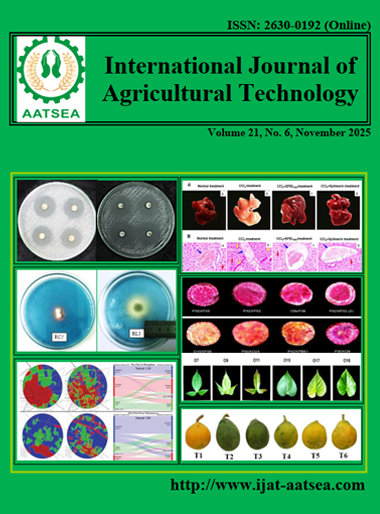
This study investigated the hepatoprotective effects of ethanol extract from Erythrina fusca Lour. fruit (EFEL) against carbon tetrachloride (CCl4)-induced liver injury in mice. EFEL was administered orally at doses of 300, 400, and 500 mg/kg for 28 days. EFEL significantly restored body weight, reduced liver weight, and normalized serum AST, ALT, ALP, and bilirubin levels compared to the CCl4 group (p < 0.05). Total protein and albumin were also improved. EFEL attenuated oxidative stress by reducing malondialdehyde (MDA) and enhancing antioxidant enzymes (SOD, GSH, TAC), while decreasing catalase activity. The levels of pro-inflammatory cytokines (TNF-α, IL-1β, IL-6) showed a marked decrease, particularly at the 500 mg/kg dose. Histopathological findings supported the biochemical results, showing preserved hepatic architecture and reduced inflammation. These results demonstrate that EFEL exerts dose-dependent hepatoprotective effects through antioxidant and anti-inflammatory mechanisms, demonstrating its promise as a liver damage treatment.
Article Details

This work is licensed under a Creative Commons Attribution-NonCommercial-NoDerivatives 4.0 International License.
References
Abbott, A. (2010). Basel declaration defends animal research. Nature, 468:742. DOI: https://doi.org/10.1038/468742a
Al-Afifi, N. A., Alabsi, A. M., Bakri, M. M. and Ramanathan, A. (2018). Acute and sub-acute oral toxicity of Dracaena cinnabari resin methanol extract in rats. BMC Complementary Medicine and Therapies, 18:50. DOI: https://doi.org/10.1186/s12906-018-2110-3
Aniagu, S. O., Nwinyi, F. C., Akumka, D. D., Ajoku, G. A., Dzarma, S., Izebe, K. S., Ditse, M., Nwaneri, P. E. C., Wambebe, C. and Gamaniel, K. (2005). Toxicity studies in rats fed nature cure bitters. African Journal of Biotechnology, 4:72-78.
Anjum, A., Sultan, M. Z., Ferdosh, S., Islam, M. K., Rashid, M. A., Nahar, L. and Sarker, S. D. (2021). Flavonoid, pterocarpans and steroid from Erythrina fusca Lour. growing in Bangladesh: isolation, and antimicrobial and free-radical scavenging activity. Journal of Medicinal Plants, 20:37-46. DOI: https://doi.org/10.52547/jmp.20.79.37
Azmi, A. S., Amini, M. H., Azman, M. F. S. N. and Salim, F. (2022). Antibacterial activity and phytochemical screening of Erythrina fusca Lour. leaf extract (Fabaceae). Science Letters, 16:60-71. DOI: https://doi.org/10.24191/sl.v16i1.15276
Bargah, R. K. and Kushwaha, P. K. (2017). Extractions, phytochemical screening and in-vitro antioxidant activity of Cassia fistula extracts. International Journal of Research in Pharmacy and Chemistry, 7:518-524.
Dong, S., Chen, Q. L., Song, Y. N., Sun, Y., Wei, B., Li, X. Y., Hu, Y. Y., Liu, P. and Su, S. B. (2016). Mechanisms of CCl4-induced liver fibrosis with combined transcriptomic and proteomic analysis. Journal of Toxicological Sciences, 41:561-572. DOI: https://doi.org/10.2131/jts.41.561
Dutta, S., Chakraborty, A. K., Dey, P., Kar, P., Guha, P., Sen, S., Kumar, A., Sen, A. and Chaudhuri, T. K. (2018). Amelioration of CCl4 induced liver injury in swiss albino mice by antioxidant rich leaf extract of Croton bonplandianus Baill. PLoS One, 13:0196411. DOI: https://doi.org/10.1371/journal.pone.0196411
Fahmy, N. M., Al-Sayed, E., El-Shazly, M. and Singab, A. S. (2018). Comprehensive review on flavonoids biological activities of Erythrina plant species. Industrial Crops and Products, 123:500-538. DOI: https://doi.org/10.1016/j.indcrop.2018.06.028
Huang, H. L., Wang, Y. J., Zhang, Q. Y., Liu, B., Wang, F. Y., Li, J. J. and Zhu, R. Z. (2012). Hepatoprotective effects of baicalein against CCl4-induced acute liver injury in mice. World Journal of Gastroenterology, 18:6605-6613. DOI: https://doi.org/10.3748/wjg.v18.i45.6605
Jiménez-Cabrera, T., Bautista, M., Velázquez-González, C., Jaramillo-Morales, O. A., Guerrero-Solano, J. A., Urrutia-Hernández, T. A. and O-Arciniega, M. D. (2020). Promising antioxidant activity of Erythrina genus: an alternative treatment for inflammatory pain. International Journal of Molecular Sciences, 22:248. DOI: https://doi.org/10.3390/ijms22010248
Johra, F. T., Hossain, S., Jain, P., Bristy, A. T., Emran, T., Ahmed, R., Sharker, S. M., Bepari, A. K. and Reza, H. M. (2023). Amelioration of CCl4-induced oxidative stress and hepatotoxicity by Ganoderma lucidum in Long Evans rats. Scientific Reports, 13:9909. DOI: https://doi.org/10.1038/s41598-023-35228-y
Kalantari, H., Jalali, M., Jalali, A., Mahdavinia, M., Salimi, A., Juhasz, B., Tosaki, A. and Gesztelyi, R. (2010). Protective effect of Cassia fistula fruit extract against bromobenzene-induced liver injury in mice. Human & Experimental Toxicology, 30:1039-1044. DOI: https://doi.org/10.1177/0960327110386256
Lee, Y. S., Cho, I. J., Kim, J. W., Lee, M. K., Ku, S. K., Choi, J. S. and Lee, H. J. (2019). Hepatoprotective effects of blue honeysuckle on CCl4‐induced acute liver damaged mice. Food Science & Nutrition, 7:322-338. DOI: https://doi.org/10.1002/fsn3.893
Munteanu, I. G. and Apetrei, C. (2021). Analytical methods used in determining antioxidant activity: A Review. International Journal of Molecular Sciences, 22:3380. DOI: https://doi.org/10.3390/ijms22073380
Nunes, C. D. R., Arantes, M. B., Pereira, S. M. D. F., Cruz, L. L. D., Passos, M. D. S., Moraes, L. P. D., Vieira, I. J. C. and Oliveira, D. B. D. (2020). Plants as sources of anti-inflammatory agents. Molecules, 25:3726-3739. DOI: https://doi.org/10.3390/molecules25163726
Pradeep, K., Mohan, C. V. R., Anand, K. G. and Karthikeyan, S. (2005). Effect of pretreatment of Cassia fistula Linn. leaf extract against subacute CCl4 induced hepatotoxicity in rats. Indian Journal of Experimental Biology, 43:526-530.
Princea, E. S., Parameswarib, P. and Khan, R. M. (2011). Protective effect of Ricinus communis leaves extract on carbon tetrachloride induced hepatotoxicity in albino rats. Iranian Journal of Pharmaceutical Sciences, 7:269-278.
Shokrzadeh, M., Khalvati, R., Hosseinzadeh, M. H., Ayatifard, M. and Habibi, E. (2022). Effects of hydroalcoholic extract of Lepidium sativum L. on carbon tetrachloride-induced hepatotoxicity in mice. Pharmaceutical and Biomedical Research, 8:225-231. DOI: https://doi.org/10.18502/pbr.v8i3.11036
Tsai, M. Y., Yang, W. C., Lin, C. F., Wang, C. M., Liu, H. Y., Lin, C. S., Lin, J. W., Lin, W. L., Lin, T. C., Fan, P. S., Hung, K. H., Lu, Y. W. and Chang, G. R. (2021). The ameliorative effects of fucoidan in thioacetaide-induced liver injury in mice. Molecules, 26:1937. DOI: https://doi.org/10.3390/molecules26071937
Tungmunnithum, D., Thongboonyou, A., Pholboon, A. and Yangsabai, A. (2018). Flavonoids and other phenolic compounds from medicinal plants for pharmaceutical and medical aspects: An overview. Medicines, 5:93. DOI: https://doi.org/10.3390/medicines5030093
Weber, L. W. D., Boll, M. and Stampfl, A. (2003). Hepatotoxicity and mechanism of action of haloalkanes: Carbon tetrachloride as a toxicological model. Critical Reviews in Toxicology, 33:105-36. DOI: https://doi.org/10.1080/713611034
