
Unleashing the potential of UAVs in agriculture: ASEAN and Thailand’s rice production industry improvements: Review article
Article Sidebar
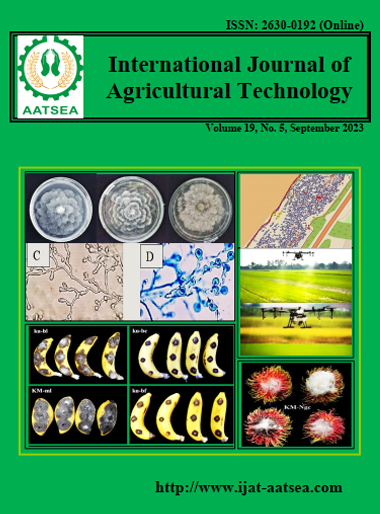
Main Article Content
Abstract
Agriculture is vital for economic sustainability and structural transformation in ASEAN. This paper explores the agricultural landscape in ASEAN, focusing on Thailand as a prominent rice producer. Challenges such as rural-urban migration, the ageing population employed in agriculture, and need to implement innovative solutions to strengthen regional food security are discussed. The primary focus is the innovative use of unmanned aerial vehicles (UAVs) in ASEAN agriculture. UAVs revolutionize data collection through aerial photography, providing real-time insights into terrain, vegetation health, and soil composition. They enable informed decisions, optimize resource allocation, and streamline processes, resulting in cost savings. Equipped with sensors, UAVs precisely monitor crop health, irrigation efficiency, and early pest detection. Integration of advanced software and geographical information systems enhances data analysis and visualization. UAVs facilitate high-resolution mapping, offering detailed information on crop density, weed infestation, and disease outbreaks. This enables targeted interventions, reducing input costs and optimizing resource allocation. Multispectral or hyperspectral sensors provide insights into plant health, chlorophyll content, and water stress, enabling site-specific management strategies for improved sustainability. UAVs are affordable, versatile, and continuously advancing. They can potentially improve productivity, efficiency, and resource management in agriculture. In rice production, UAVs offer benefits like crop monitoring, precise spraying, and uniform seed spreading. They provide real-time information on crop health and pest infestations, enabling optimized management. Spray drones accurately apply pesticides, while seed-spreading drones enhance crop growth and save costs. UAV drones offer significant advantages in ASEAN agriculture, addressing workforce challenges and enhancing productivity. Supportive measures will lead to efficient UAV integration, enhancing sustainability and farmer livelihoods
Article Details

This work is licensed under a Creative Commons Attribution-NonCommercial-NoDerivatives 4.0 International License.
References
Bogue, R. (2021). Robots poised to transform agriculture. Industrial Robot: the international journal of robotics research and application, 48:637-642.
Hoang, V. V. (2020). Investigating the agricultural competitiveness of ASEAN countries. Journal of Economic Studies, 47:307-332.
Javaid, M., Haleem, A., Singh, R. P. and Suman, R. (2022). Enhancing smart farming through the applications of Agriculture 4.0 technologies. International Journal of Intelligent Networks, 3:150-164.
Kagita, M. K., Kaosar, M. and Thilakarathne, N. (2022). Survey on AI-based IoT and drone-equipped smart agriculture. Artificial Intelligence of Things in Smart Environments, Applications in Transportation and Logistics, pp.101-114.
Khan, D., Nouman, M., Popp, J., Khan, M. A., Ur Rehman, F. and Oláh, J. (2021). Link between technically derived energy efficiency and ecological footprint: Empirical evidence from the ASEAN region. Energies, 14: 3923.
Liu, Y., Ma, X., Shu, L., Hancke, G. P. and Abu-Mahfouz, A. M. (2020). From Industry 4.0 to Agriculture 4.0: Current status, enabling technologies, and research challenges. IEEE Transactions on Industrial Informatics, 17:4322-4334.
Maddikunta, P. K. R., Hakak, S., Alazab, M., Bhattacharya, S., Gadekallu, T. R., Khan, W. Z. and Pham, Q. V. (2021). Unmanned aerial vehicles in smart agriculture: Applications, requirements, and challenges. IEEE Sensors Journal, 21:17608-17619.
Mizik, T., Szerletics, Á. and Jámbor, A. (2020). Agri-food export competitiveness of the asean countries. Sustainability, 12:9860.
Muraru, S. L., Cardei, P., Muraru, V., Sfîru, R. and Condruz, P. (2019). Researches regarding the use of drones in agriculture. International Multidisciplinary Scientific GeoConference: SGEM, 19:683-690.
Negash, L., Kim, H. Y. and Choi, H. L. (2019, November). Emerging UAV applications in agriculture. In 2019 7th International Conference on Robot Intelligence Technology and Applications (RiTA) (pp. 254-257). IEEE.
Panpluem, N., Mustafa, A., Huang, X., Wang, S. and Yin, C. (2019). Measuring the technical efficiency of certified organic rice producing farms in Yasothon province: Northeast Thailand. Sustainability, 11:6974.
Puriwat, W. and Tripopsakul, S. (2020). Preparing for Industry 4.0--Will Youths Have Enough Essential Skills?: An Evidence from Thailand. International Journal of Instruction, 13:89-104.
Ruiz Salvago, M., Phiboon, K., Faysse, N. and Nguyen, T. P. L. (2019). Young people’s willingness to farm under present and improved conditions in Thailand. Outlook on Agriculture, 48:282-291.
Sharma, S., Verma, K. and Hardaha, P. (2023). Implementation of artificial intelligence in agriculture. Journal of Computational and Cognitive Engineering, 2:155-162.
Thompson, L. J. and Puntel, L. A. (2020). Transforming unmanned aerial vehicle (UAV) and multispectral sensor into a practical decision support system for precision nitrogen management in corn. Remote Sensing, 12:1597.
Triantafyllou, A., Sarigiannidis, P. and Bibi, S. (2019). Precision agriculture: A remote sensing monitoring system architecture. Information, 10:348.
Yaqot, M. and Menezes, B. C. (2021). Unmanned aerial vehicle (UAV) in precision agriculture: business information technology towards farming as a service. In 2021 1st International Conference on Emerging Smart Technologies and Applications (eSmarTA) (pp. 1-7). IEEE.
Yinka-Banjo, C. and Ajayi, O. (2019). Sky-farmers: Applications of unmanned aerial vehicles (UAV) in agriculture. Autonomous vehicles, 107-128.
