Selection of sesame genotypes with high oil content and large seed size
Article Sidebar
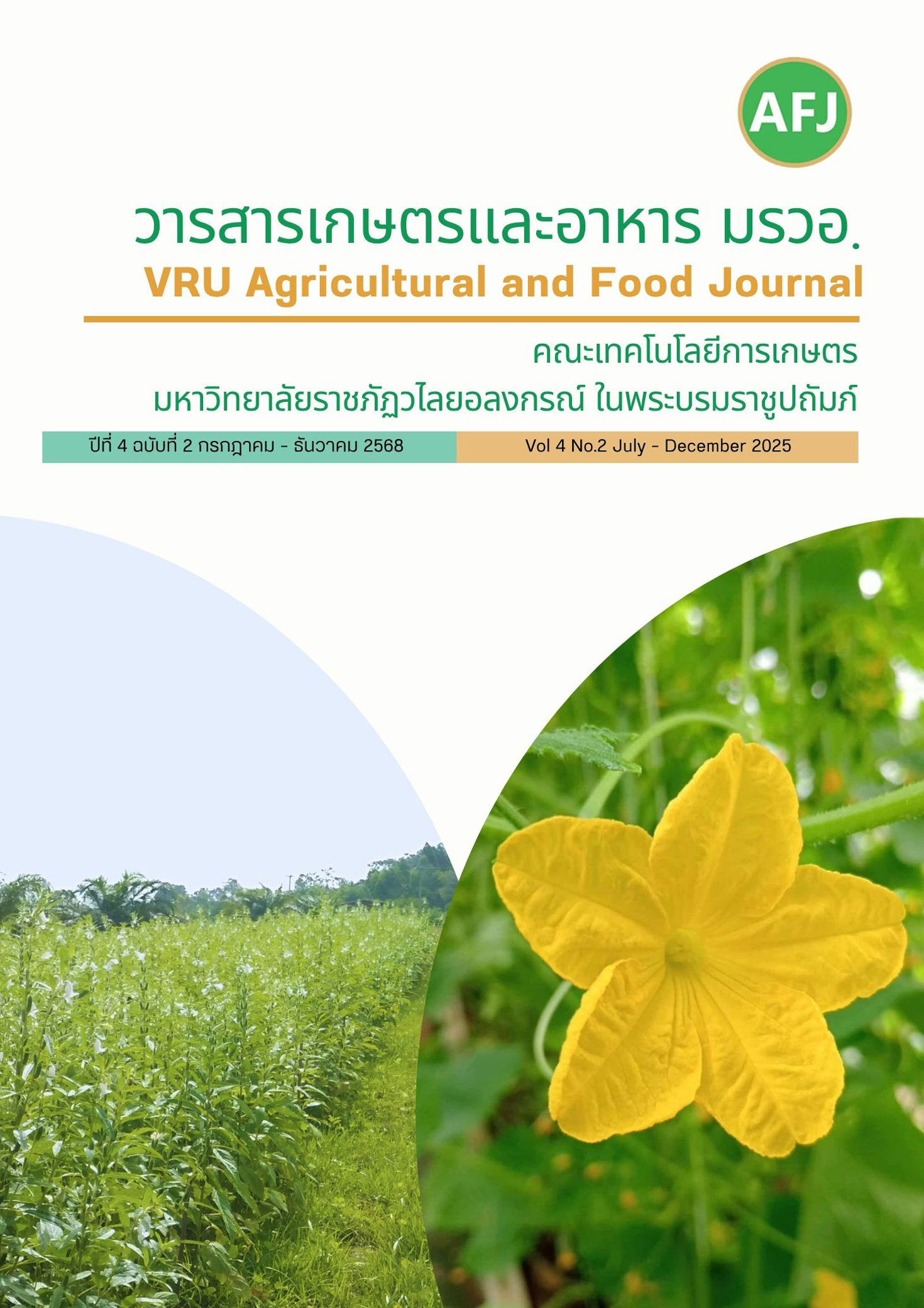
Main Article Content
Abstract
Sesame (Sesamum indicum L.) is an economically significant oilseed crop in Thailand, with increasing demand for its seeds in both domestic and international markets. However, sesame production for processing and export remains limited due to high variability in seed size and oil content among local cultivars, leading to inconsistent seed quality and reduced market competitiveness. This study aimed to identify sesame lines with high oil content, large and well-developed seeds, and uniform seed color. The experiment was conducted at the Ubon Ratchathani Field Crops Research Center in 2022 during two cropping seasons: early and late rainy seasons. In the early rainy season, 30 sesame lines from the germplasm collection were evaluated. The red sesame line RS56-08-02 produced the highest seed yield (120 kg/rai), the white sesame line PWS56-5-3-26 exhibited the highest oil content (50.8%), and the white line NS56-41-4-3 had the highest 1,000-seed weight (3.09 g). In the late rainy season, the white sesame line PI436601 had the highest seed yield (123 kg/rai), PWS56-5-3-26 again showed the highest oil content (50.9%), and the Myanmar white sesame variety had the highest 1,000-seed weight (3.57 g). Based on the results, four sesame lines were selected for their superior oil content and seed size: white sesame lines PWS56-5-3-26 and Cplus 1 (high oil content), and white lines NS56-41-4-3 and DOA Ubon Ratchathani 2 (large seed size). These lines are considered promising candidates for future breeding programs aimed at improving sesame quality and productivity.
Article Details

This work is licensed under a Creative Commons Attribution-NonCommercial-NoDerivatives 4.0 International License.
This article is published under a Creative Commons Attribution-NonCommercial-NoDerivatives 4.0 International License (CC BY-NC-ND 4.0), which allows others to share the article with proper attribution to the authors and prohibits commercial use or modification. For any other reuse or republication, permission from the journal and the authors is required.References
คู่มือการใช้เครื่อง Soxtec 8000. มปป. บริษัทสิทธิพรแอสโซซิเอส จำกัด แผนกห้องปฏิบัติการ SPD3.29 หน้า.
จุไรรัตน์ หวังเป็น, สมใจ โควสุรัตน์, ธำรง เชื้อกิตติศักดิ์, นภาพร คำนวณทิพย์, และศิริวรรณ อำพันฉาย. 2564. การปรับปรุงพันธุ์งาฝักไม่แตกง่าย : การเปรียบเทียบในไร่เกษตรกร. หน้า 1-17. ใน : รายงานผลงานวิจัย ปี 2563 ศูนย์วิจัยพืชไร่อุบลราชธานี สถาบันวิจัยพืชไร่และพืชทดแทนพลังงาน กรมวิชาการเกษตร.
ธำรง เชื้อกิตติศักดิ์, สมใจ โควสุรัตน์, จุไรรัตน์ หวังเป็น, สาคร รจนัย, และจำลอง กกรัมย์. 2560. การปรับปรุงพันธุ์งาแดงผลผลิตสูงชุดปี 2556 : การเปรียบเทียบเบื้องต้น ใน : รายงานผลงานวิจัย ปี 2560 ศูนย์วิจัยพืชไร่อุบลราชธานี สถาบันวิจัยพืชไร่และพืชทดแทนพลังงาน กรมวิชาการเกษตร. หน้า 7-21.
นิวัฒ เสนาะเมือง, และพิศาล ศิริธร. 2539. สรุปงานวิจัยโรคงา มหาวิทยาลัยขอนแก่น ระหว่างปี 2529-2539. หน้า 101-106. ใน : เอกสารวิชาการงา. กรมวิชาการเกษตร กรมส่งเสริมการเกษตร มหาวิทยาลัยขอนแก่น มหาวิทยาลัย เกษตรศาสตร์ สถาบันเทคโนโลยีเกษตรแม่โจ้.
วาสนา วงษ์ใหญ่. 2550. งา : พฤกษศาสตร์ การปลูก ปรับปรุงพันธุ์ และการใช้ประโยชน์. ภาควิชาพืชไร่นา มหาวิทยาลัยเกษตรศาสตร์ กรุงเทพฯ. 257 หน้า.
สาคร รจนัย, นภาพร คำนวณทิพย์, ปริยพัชร ทองมั่น, ธำรง เชื้อกิตติศักดิ์, สมใจ โควสุรัตน์, จุไรรัตน์ หวังเป็น, มลุลี สิทธิษา, และสมหมาย วังทอง. 2563. การปรับปรุงพันธุ์งาขาวเพื่อผลผลิตสูงชุดปี 2556 : การเปรียบเทียบในไร่เกษตรกร. ใน : รายงานผลงานวิจัย ปี 2563 ศูนย์วิจัยพืชไร่อุบลราชธานี สถาบันวิจัยพืชไร่และพืชทดแทนพลังงาน กรมวิชาการเกษตร. หน้า 34-48.
Agidew, M. G., Dubale, A. A., Atlabachew, M., & Abebe, W. 2021. Fatty acid composition, total phenolic contents and antioxidant activity of white and black sesame seed varieties from different localities of Ethiopia. Chemical and biological technologies in agriculture, 8(1), 14.
Aslam, F., Iqbal, S., Imran, M., Anjum, A. A., Gilani, S. A., Farooq, Z., & Shariati, M. A. 2021. Characterization of white sesame seed oil and its bioactive components. Journal of microbiology, biotechnology and food sciences, 10(6), e4641-e4641.
Hwang L.S. 2005. Sesame oil. Bailey’s industrial oil and fat product, sixth edition, six volume set : 537 – 576.
Lee, J.I., B.H. Lee, N.S. Seong and C.W. Kang. 1991. Studies on interspecific hybridization in sesame I. Characteristics and cross affinity of mild sesame Korean J.Breed. 22: 356-360.
Namiki, M. 1995. The chemistry and physiological functions of sesame. Food Rev. Int. 11: 281-329.
Wang, L., Zhang, Y., Li, D., Dossa, K., Wang, M. L., Zhou, R., & Zhang, X. (2019). Gene expression profiles that shape high and low oil content sesames. BMC genetics, 20(1), 45.
Yermanos, D.M., S. Hemstreet, W. Saleeb and C.K. Huszar. 1972. Oil content and composition of the seed in the world collection of sesame introduction. J. Am. Oil Chem. Soc. 49: 20-23.
